Can the Philippines unlock its demographic dividend?
The Philippines has among Southeast Asia’s youngest population. But can this turn into productivity, higher incomes, and sustainable economic growth?
September 10, 2026 by Anna Cudia
Share this article:
Discussions over a young and growing labor force often center on headline consumption and economic growth figures. But demographics shape economies over much longer periods.
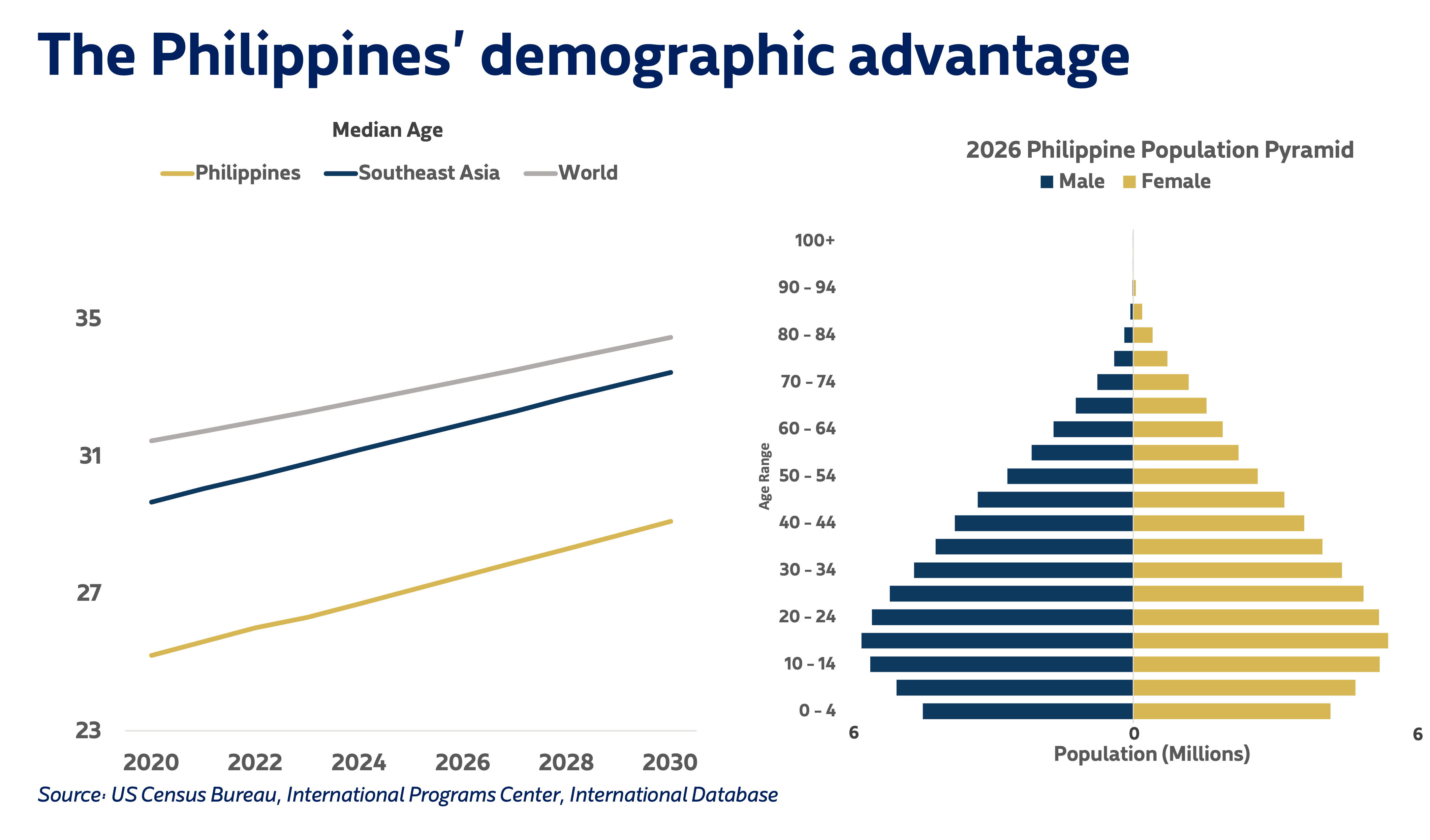
The Philippines’ relatively young population and an expanding labor force position it to benefit from favorable demographic trends. The challenge is converting that to lasting economic gains.
What is a demographic dividend?
A demographic dividend occurs when the working-age population grows faster than the number of dependents. This creates more potential workers than those who rely on them for support.
In theory, more workers boost production, incomes, savings, and spending—creating a virtuous economic growth cycle. However, the benefits may only materialize when people are productive and contribute meaningfully to the economy.
Why is the Philippines often viewed as a demographic story?
The Philippines, with its growing working-age population, is one of Southeast Asia’s youngest countries.
This gives it a longer demographic runway than many in the region. In contrast, several Asian economies grapple with aging populations and shrinking workforces. These may present challenges as fewer workers support a growing number of retirees.
However, the Philippines’ demographic advantage is not permanent. It is gradually moving toward an older population structure, with the fertility rate falling below the 2.1 replacement level, according to the Philippine Statistics Authority's 2025 National Demographic and Health Survey. While the population is still relatively young today, the window to fully benefit from the demographic dividend appears to be narrowing.
For now, the Philippines’ young population remains a potential competitive advantage.
Why is the Philippines a consumption-driven economy?
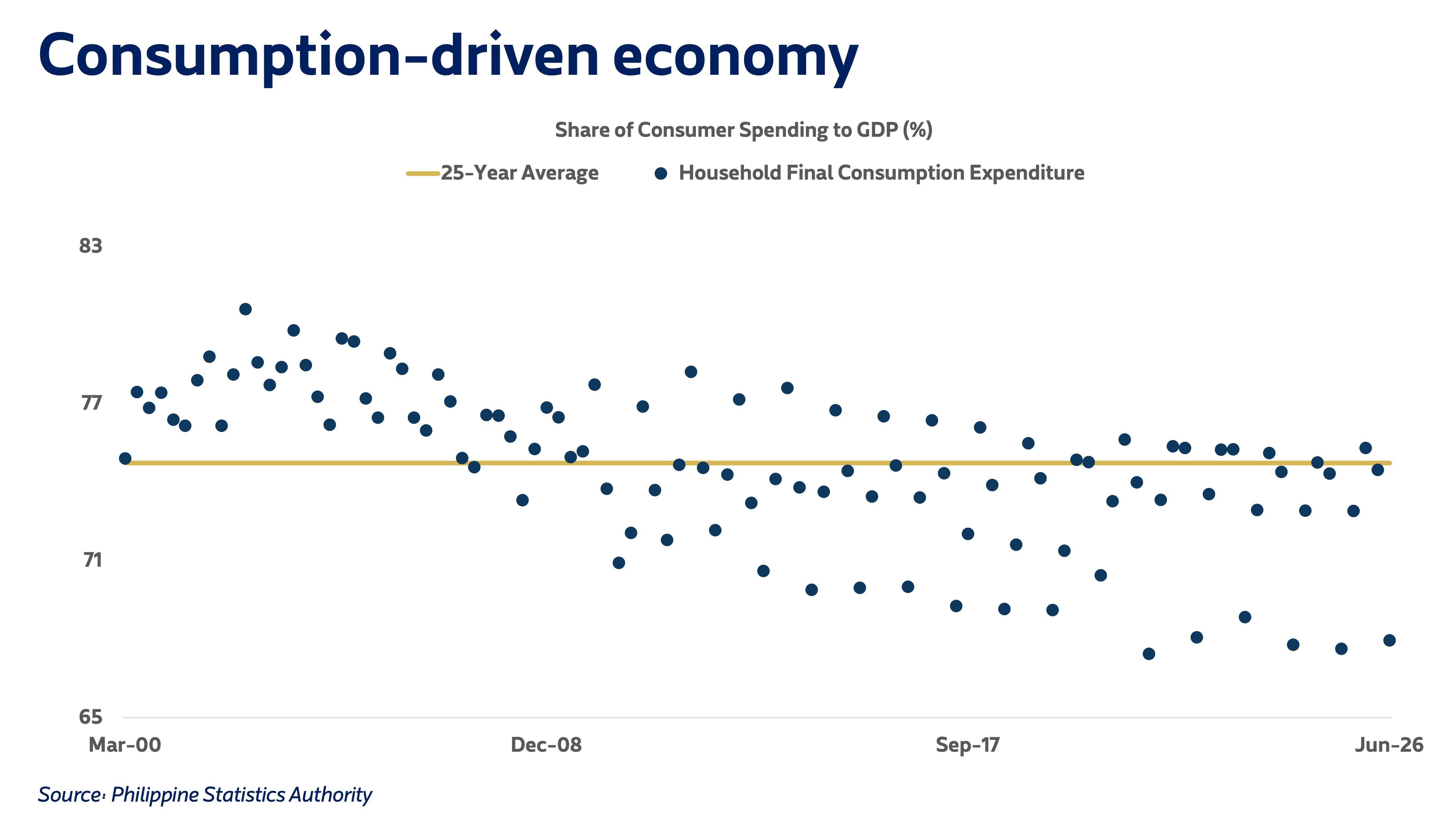
Household spending drives the Philippine economy, accounting for over 70% of gross domestic product in the past 25 years.
Part of this reflects demographics. Younger populations tend to spend more on housing, education, and transportation. Overseas remittances further support purchasing power and consumer demand.
Strong domestic consumption also fuels growth in service-oriented industries like retail and telecommunications. As more people enter the workforce and earn, consumption typically rises alongside economic activity.
In many cases, the first sign of a demographic dividend is stronger consumption.
Is productivity the real dividend?
Long-term prosperity may depend more on productivity than workforce size alone.
A larger labor force can support growth, but sustained improvements in living standards require more productive workers over time. This is why some economies with aging populations continue to grow incomes through innovation, technological adoption, and investment in human capital.
The goal is to equip workers with skills, leverage technology, and create opportunities needed to create greater value.
Demographics may open the door for growth, but productivity determines how far the economy can go.
How can the Philippines capture the dividend?
Ultimately, a large workforce becomes a true economic asset only when workers are skilled, productive, and have opportunities.
Without enough productive jobs, a young population may become underutilized. Productivity matters as much as employment. Jobs that create little value are unlikely to deliver meaningful gains in incomes or living standards over the long run.
Education and skills development must keep pace with rapidly changing labor requirements. In an increasingly digital and technology-driven economy, adaptability and continuous learning are essential.
Infrastructure and investment are also important. Businesses need reliable transport, energy, and digital networks to expand efficiently. Meanwhile, domestic and foreign investment provides the capital for jobs creation.
Sectors tied to domestic demand, like consumer goods, education, and infrastructure, face long-term opportunities.
However, investors should recognize that demographics are a long-term structural theme rather than a short-term market catalyst. The benefits unfold gradually and depend on how effectively demographic potential converts to productivity and income growth.
Conclusion
The Philippines’ young population is among its valuable long-term assets. Yet favorable demographics are not a guarantee for economic success.
Productivity is the real dividend. The ability to create jobs, improve productivity, attract investment, and strengthen human capital determines whether today’s young population becomes tomorrow’s growth engine.
For investors, the Philippines’ demographic story remains compelling. But ultimately, the greatest opportunity lies not in population growth, but transforming that into sustainable economic progress.
(Disclaimer: This is general investment information only and does not constitute an offer or guarantee, with all investment decisions made at your own risk. The bank takes no responsibility for any potential losses.)
ANNA DOMINIQUE CUDIA, MBA, CSS, oversees Metrobank’s Macro Research Department, steering macroeconomic and financial market analyses for clients. She previously led the Markets Research Department of Metrobank’s Trust Banking Group and was part of Investor Relations, supporting multi-billion peso and US dollar capital-raising initiatives. She holds an MBA in Finance, with distinction, from the University of London, and industry certifications in finance. Outside of work, she enjoys travel and exploring new perspectives.