


Economy3 MIN READ
How to manage peso weakness through hedging
Learn more about how foreign exchange hedging can help you manage risks in this volatile environment.
June 16, 2026 by Anna Cudia
Share this article:

With the peso devaluation in the Philippines pushing the currency above the PHP 60-per-US-dollar level, currency moves are once again in focus for both businesses and individuals.
While foreign exchange (FX) volatility is normal, large swings can affect budgets, costs, and financial plans—making preparation more important than reaction.
FX refers to the conversion of one currency into another. Exchange rates move based on supply and demand for currencies, shaped by trade flows, capital movements, and market sentiment.
Several factors influence forex rates. Interest rate decisions matter—higher rates often attract foreign investors, supporting a currency. Central bank actions or even signals of possible intervention can also move markets. Political or economic uncertainty may cause investors to pull out funds, weakening the local currency.
Trade and investment flows play a role as well. Countries that import more than they export typically need more foreign currency, which can pressure the exchange rate. On the other hand, foreign investments and remittances increase demand for the local currency, helping support it. Global developments also matter, as currencies are always priced relative to another—often the US dollar.
Why is the Philippine peso weak? The answer lies in a combination of global and domestic pressures. Heightened geopolitical tensions have pushed investors toward safe-haven assets like the US dollar, weighing on emerging market currencies. Higher global oil prices have also raised import costs for the Philippines, increasing demand for dollars.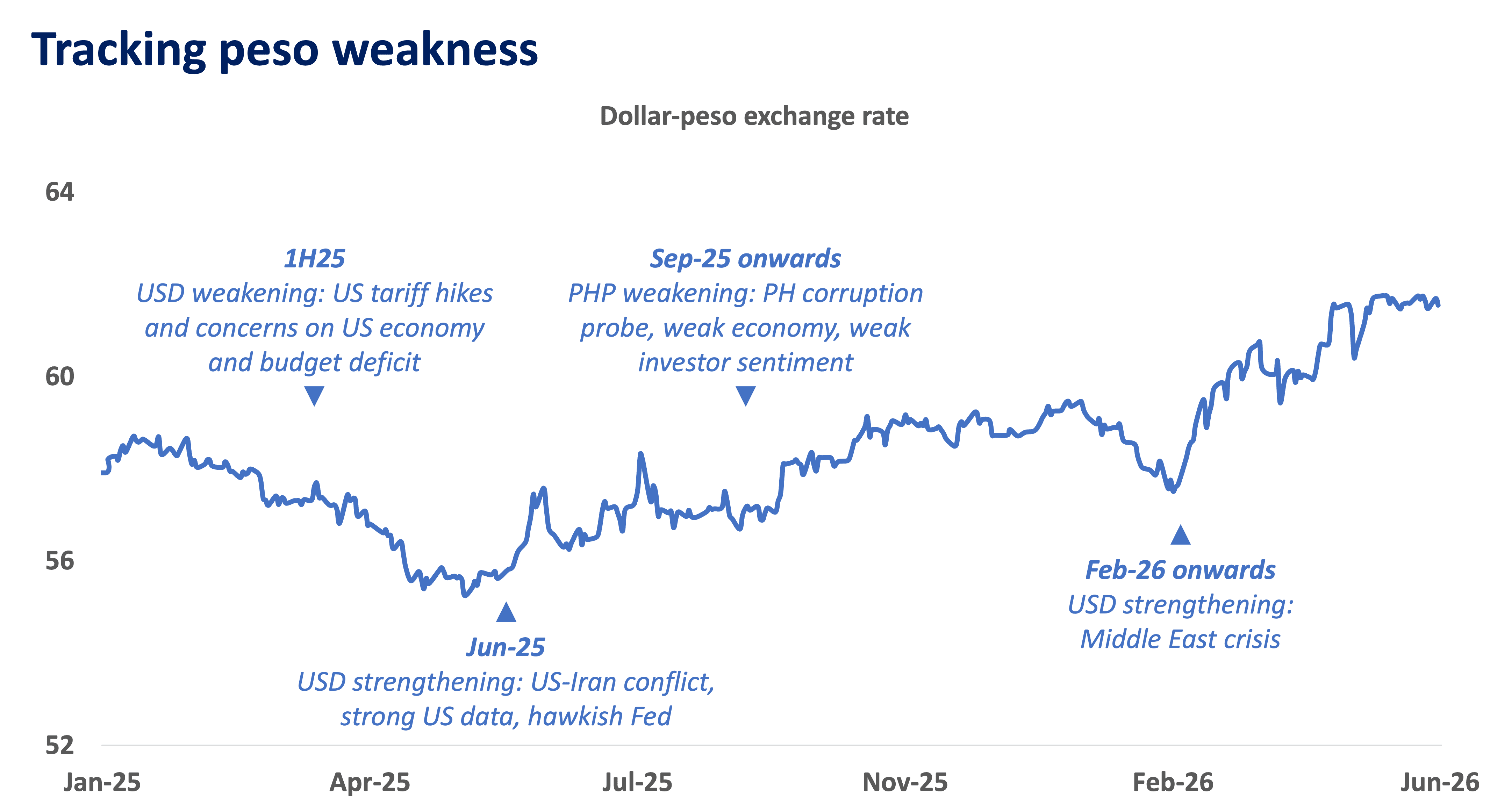
Sources: Bloomberg, Metrobank Research
Peso devaluation in the Philippines can amplify higher global commodity prices—such as today’s elevated oil prices—by increasing the cost of imports, which contributes to higher inflation. A weaker peso benefits exporters and overseas Filipino families, as foreign earnings go further.
However, importers face higher input costs, while airlines, shipping firms, and manufacturers may see margins squeezed. Travelers, students abroad, and online shoppers also feel the impact, as foreign expenses rise.
Because FX movements can be swift and unpredictable, managing currency risk is a key part of financial planning.
Knowing why the Philippine peso is weak is one thing—knowing how to respond is another.
For companies, currency swings influence import costs, foreign-currency loans, and cash flow planning. Without preparation, peso weakness can lead to higher expenses and tighter margins.
On the other hand, for foreign-currency earners such as business process outsourcing (BPO) firms, peso weakness can support earnings. Using FX hedging, companies may protect current exchange rate levels, allowing them to plan revenues more confidently amid volatile market conditions.
For individuals, FX risk shows up in travel spending, overseas tuition, investments, and large foreign-currency purchases. Poor timing on conversions can significantly raise costs.
But there is a way to manage these risks. This is where proactive FX risk management becomes important.
FX hedging helps manage the risk of unfavorable currency moves. It involves using financial contracts to fix or manage future exchange rates tied to actual transactions.
Hedging is not meant for speculation or profit-seeking. Think of it as insurance: it protects against adverse outcomes but may also limit upside if the market moves favorably.
Common hedging tools include FX forwards, which lock in an exchange rate for a future payment, and FX options, which give the right—but not the obligation—to buy or sell foreign currency at a predetermined rate.
By fixing exchange rates in advance, businesses can maximize profitability, plan cash flows more accurately and reduce uncertainty—even if it means giving up some potential gains. The trade-off is often greater budget stability and financial clarity.
Yes. Individuals can manage FX exposure by planning conversions ahead of large expenses, spreading conversions over time, or holding savings and investments in more than one currency. Keeping an eye on FX movements can also help individuals time large conversions more strategically.
This is where you consult your wealth advisor. If you are a Metrobank client, consult your Relationship Manager, Wealth Specialist, or Markets Sales Personnel to explore strategies aligned with your goals and risk appetite.
If you wish to start your wealth journey with Metrobank, just go to any branch and inquire.
And don’t forget that in volatile markets, preparation is protection. Thoughtful FX planning can help turn uncertainty into confidence.
ANNA DOMINIQUE CUDIA, MBA, CSS, oversees Metrobank’s Macro Research Department, steering macroeconomic and financial market analyses for clients. She previously led the Markets Research Department of Metrobank’s Trust Banking Group and was part of Investor Relations, supporting multi-billion peso and US dollar capital-raising initiatives. She holds an MBA in Finance, with distinction, from the University of London, and industry certifications in finance. Outside of work, she enjoys travel and exploring new perspectives.
The Philippine peso devaluation is being driven by a mix of external and domestic pressures.
On the global side, heightened geopolitical tensions have pushed investors toward safe-haven assets like the US dollar, putting broad pressure on emerging market currencies. Higher oil prices have compounded this by increasing the Philippines' import bill and demand for dollars.
Domestically, a persistent current account deficit—where the country imports more than it exports—adds further strain on the peso.
No. While businesses with significant import costs or foreign-currency loans benefit most directly from formal hedging instruments like FX forwards and options, individuals with large upcoming foreign-currency expenses—such as overseas tuition, travel, or property purchases—can also take steps to manage FX risk. These include planning conversions in advance, spreading them over time, and holding savings in more than one currency.
There's no perfect time, which is precisely why hedging exists—it removes the need to predict. That said, monitoring forex rates and staying informed on broader economic signals can help you act with more confidence rather than reacting to sudden moves.
If you have a known future payment in foreign currency, locking in a rate sooner rather than later reduces your exposure to volatility.