







February Economic Update: Cut to the chase
 DOWNLOAD

Inflation Update: Nowhere but up
DOWNLOAD

Philippines Trade Update: Imports weaken on tepid demand
DOWNLOAD


Peso weakens as markets eye key US data
 By BusinessWorld
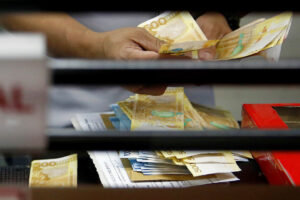


The peso went down against the dollar on Tuesday as market players stayed on the sidelines before key US economic data releases later this week.
The local unit weakened by 7.5 centavos to close at PHP 58.53 versus the greenback from its PHP 58.455 finish on Monday, data from the Bankers Association of the Philippines showed.
The currency opened Tuesday’s trading session slightly stronger at PHP 58.40 against the dollar. It climbed to as high as PHP 58.38, while its worst showing was its closing level of PHP 58.53
Dollars traded increased to USD 1.179 billion from USD 1.08 billion on Monday.
“The peso weakened ahead of a likely upbeat US retail sales report,” the first trader said in an e-mail.
“The dollar-peso traded with a slight upward bias but closed at its intraday high on cautious positioning ahead of US data,” the second trader said, adding that the market is awaiting reports on retail sales, nonfarm payrolls, and inflation.
For Wednesday, the first trader expects the peso to range from PHP 58.40 to PHP 58.65 per dollar, while the second trader sees it moving between PHP 58.30 and PHP 58.60.
Meanwhile, the US dollar extended Monday’s decline against the yen after Prime Minister Sanae Takaichi’s election victory, while remaining little changed against European currencies before key economic data due on Wednesday.
The Japanese currency snapped a six‑day losing streak on Monday after falling toward the 160 threshold against the greenback, triggering fears of intervention by Japanese authorities to support the yen.
However, analysts also noted that Ms. Takaichi’s policy, which includes tax cuts and more fiscal spending, is expected to boost the economy and lift the stock market, potentially prompting a more hawkish Bank of Japan, all factors that could support the yen.
The yen rose 0.23% to ¥155.52 against the dollar after jumping 0.85% the day before.
It was up 0.32% at ¥185.18 versus the euro after being roughly unchanged on Monday.
“With Prime Minister Sanae Takaichi moving from a relatively fiscally conservative stance to one favoring carefully targeted stimulus, the balance of risks has tilted toward additional tightening from the Bank of Japan,” said Harvey Bradley, co-head of global rates at Insight Investment, arguing that a neutral rate around 1.5% looks reasonable.
“Takaichi’s planned election is aimed at consolidating her position, but a realignment among opposition parties may complicate that ambition and should reassure markets that the fiscal outlook is not going to meaningfully deteriorate,” he added.
Investor attention will be on the monthly reports covering US employment and consumer prices that were pushed back slightly due to a recent three-day government shutdown.
White House economic adviser Kevin Hassett said on Monday that US job gains could be lower in the coming months due to slower labor force growth and higher productivity. Investors are trying to assess whether weakening in the labor market has tapered off.
The dollar index, which measures the greenback against six other currencies, was roughly unchanged at 96.90, after hitting a fresh one-week low at 96.789. — A.M.C. Sy with Reuters
This article originally appeared on bworldonline.com