






February Economic Update: Cut to the chase
 DOWNLOAD

Inflation Update: Nowhere but up
DOWNLOAD
Philippines Trade Update: Imports weaken on tepid demand
DOWNLOAD


Informal work fills the gap as Philippine economic growth slows
 By BusinessWorld
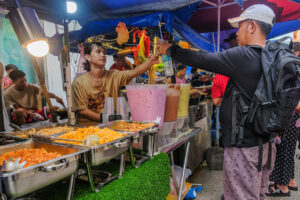


Freny C. Dongoya sells pares — Filipino comfort food made of braised beef in a sweet-savory soy sauce served with garlic fried rice — for PHP 120 (USD 2) a plate in Pasay City near the Philippine capital.
On most days, her customers are call center agents and motorcycle riders grabbing quick meals between shifts. She hasn’t raised prices despite higher food costs.
“If I increase prices, they stop coming,” she told BusinessWorld in Filipino. “Then I earn nothing.”
Ms. Dongoya works long hours, but she’s not counted in official job statistics. Like millions of Filipinos, she operates in the informal economy — without permits, tax registration or social protection.
Her situation captures the tension in the Philippine economy as it enters 2026.
Growth slowed sharply last year. Full-year expansion in 2025 eased to 4.4%, the weakest in 14 years excluding the pandemic. Infrastructure spending stalled and global trade softened. Yet officials continue to project confidence about reaching upper middle-income status.
On the ground, the picture looks uneven.
Outside business districts such as Bonifacio Global City and Ortigas, much of the workforce depends on low-paid, unstable jobs. Informal workers sell food, run small stores or take on casual labor. They cushion daily life for formal workers — but see little benefit from economic growth.
About 42% of the workforce or 20.6 million Filipinos remain in informal employment, according to estimates by IBON Foundation.
Christopher James R. Cabuay, an associate professor of economics at De La Salle University in Manila, said this helps explain why growth feels disconnected from household income.
“The current growth model is not structured to favor those in the informal sector,” he told BusinessWorld via teleconference.
“Most of the jobs we produce are in sectors like wholesale and retail trade or accommodation and food services. These employ many workers, but value-added per worker is small, so wages grow slowly,” he added.
Productivity gains are limited, and many workers stay near subsistence levels even during expansion years.
High-value sectors tell a different story. Business process outsourcing, finance and information technology earn in foreign currency and benefit from global demand. These industries helped stabilize growth during external shocks.
But their gains don’t spread evenly.
Analysts describe this as a two-track economy. One track is globally linked and relatively stable. The other is local, informal, and exposed to inflation and weak demand.
Warfredo Alejandro II works in the first track. The 27-year-old is a credit card specialist in the business process outsourcing sector. He has a steady paycheck and benefits. But he depends on the informal economy to manage daily costs.
He notes that affordable meals from vendors like Ms. Dongoya are the only way many employees can stretch their take-home pay.
“Street vendors make life affordable,” he said. “Without them, many employees would struggle to stretch their salaries.”
‘Hidden safety net’
Mom-and-pop stores and food stalls cluster around office towers for a reason. They sell cheap meals and essentials. For workers on entry-level wages, that matters.
Alellie B. Sobreviñas, an associate professor of economics at La Salle, said informal vendors act as an economic buffer for urban workers.
“They are a hidden safety net” especially for workers with long or irregular hours, she said in an e-mailed reply to questions.
When authorities clear sidewalks or relocate vendors without alternatives, costs rise quickly. Workers pay more for food. Commute times increase. Disposable income shrinks.
“That is an effective pay cut,” Ms. Sobreviñas said.
This does not mean informality is desirable, she said. Informal workers lack protection, access to credit and legal security. But removing them without replacing the services they provide creates pressures.
Formalization is often presented as the solution. In practice, it is costly.
For a small food vendor, registering a business requires multiple permits, fees and tax compliance. Costs can reach tens of thousands of pesos. For operators earning thin margins, that’s out of reach.
Ms. Dongoya pays her helpers PHP 400 to PHP 500 a day — below Metro Manila’s PHP 695 minimum wage, which only applies to formal jobs.
Mr. Cabuay said this creates another gap. Wage policies help those already inside the system. They do little for those outside it.
“The difference between what an informal worker earns and what they could earn in the formal jobs available to them is often not that large,” he said.
Many formal openings are also low skill: cleaners, service crew and laborers. They offer stability but limited wage gains. For some workers, informality still pays more.
This weak incentive slows formalization and keeps productivity low.
Economists warn that this structure limits long-term growth. Without stronger manufacturing and higher-value domestic industries, job quality will remain constrained.
Mr. Cabuay and his colleagues have raised concerns about government targets of 6% to 8% growth. Without upgrading jobs, growth will not translate into higher incomes for most workers.
Other barriers remain. Small firms struggle to access credit. Regulations are complex and public investment has been uneven.
The result is an economy that grows without lifting the base.
In business districts, consumption looks strong. Malls are busy and offices are full. But many households remain one shock away from hardship.
For informal workers, inflation hits first and hardest. Food and fuel costs rise, earnings don’t adjust quickly and savings are limited, yet their role remains essential.
Without informal vendors, entry-level formal workers would face higher living costs. Without informal transport, commutes would be longer. Without small retailers, neighborhoods would lose access to cheap goods.
The challenge is not choosing between formal and informal work. It is closing the gap between them.
That means lowering the cost of formalization, improving access to credit, and creating jobs that pay more because they produce more.
Until then, growth will continue to feel abstract for millions.
Ms. Dongoya doesn’t talk about gross domestic product targets. She watches foot traffic and rice prices.
“If customers disappear, I disappear,” she said.
For now, they keep coming. That says as much about the Philippine economy as any official forecast. — Erika Mae P. Sinaking
This article originally appeared on bworldonline.com