More than oil: The US-Iran conflict’s cost for the Philippines


The fragile state of the Middle East conflict has stoked energy prices, with its impact seen spilling onto other costs and rippling through the Philippines’ bond yields and stock prices.
The conflict has resulted in maritime traffic in the Strait of Hormuz, a critical trade route, plummeting to 10 vessels a day from an average of 138, according to the Joint Maritime Information Center.
This has led to a 40% surge in energy costs relative to pre-conflict levels, impacting crude oil, Liquefied Petroleum Gas, Liquefied Natural Gas, and refined petroleum products.
The economic repercussions extend beyond the energy sector. The strait also serves as a vital passage for chemicals and fertilizers, accounting for roughly 13% of total transit volume.

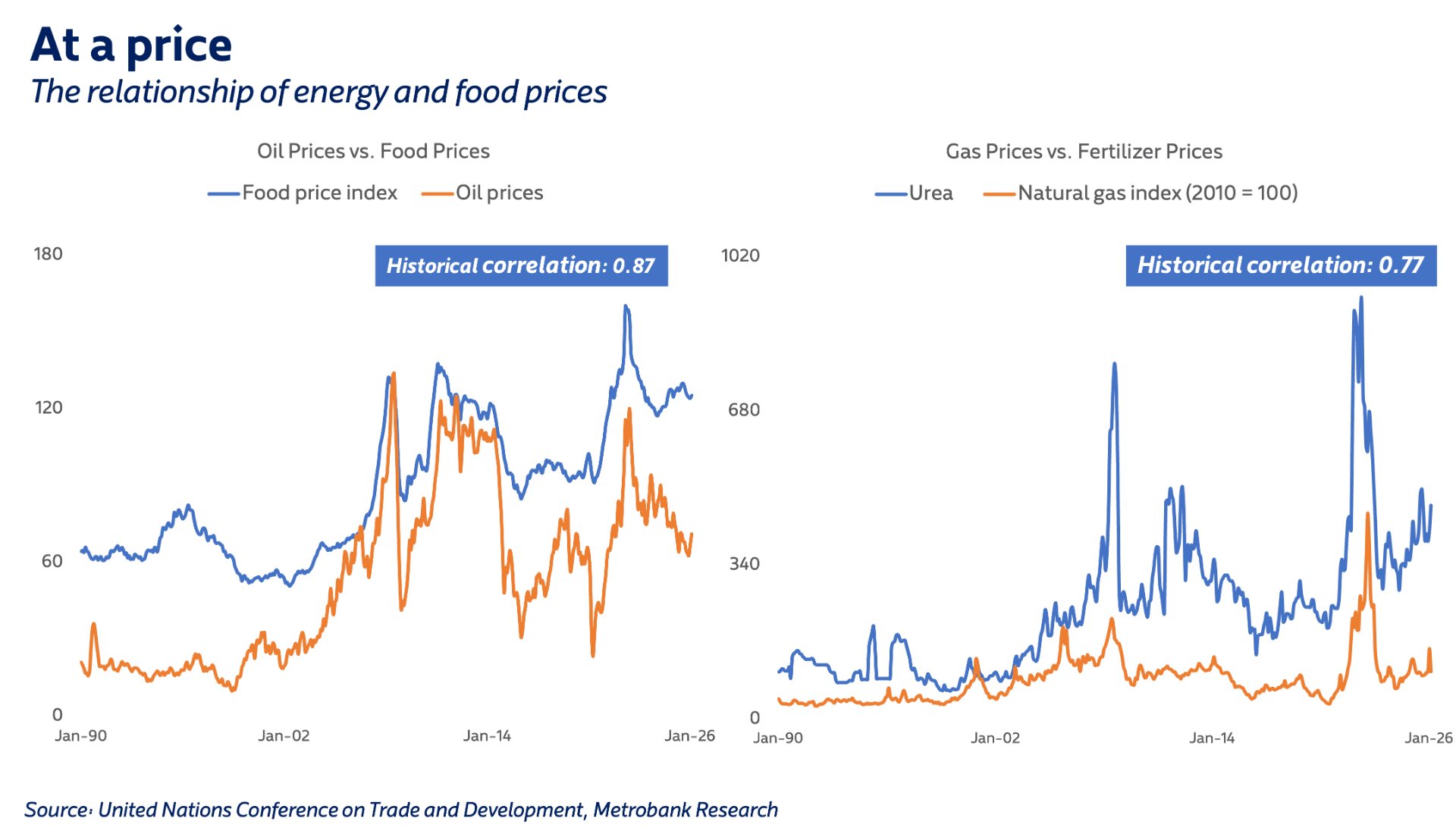
Moreover, energy prices have a strong positive correlation with agricultural inputs. Elevated raw material and operational costs drive a spike in food and fertilizer prices.
The Philippines faces heightened inflationary risks due to its reliance on imported commodities.
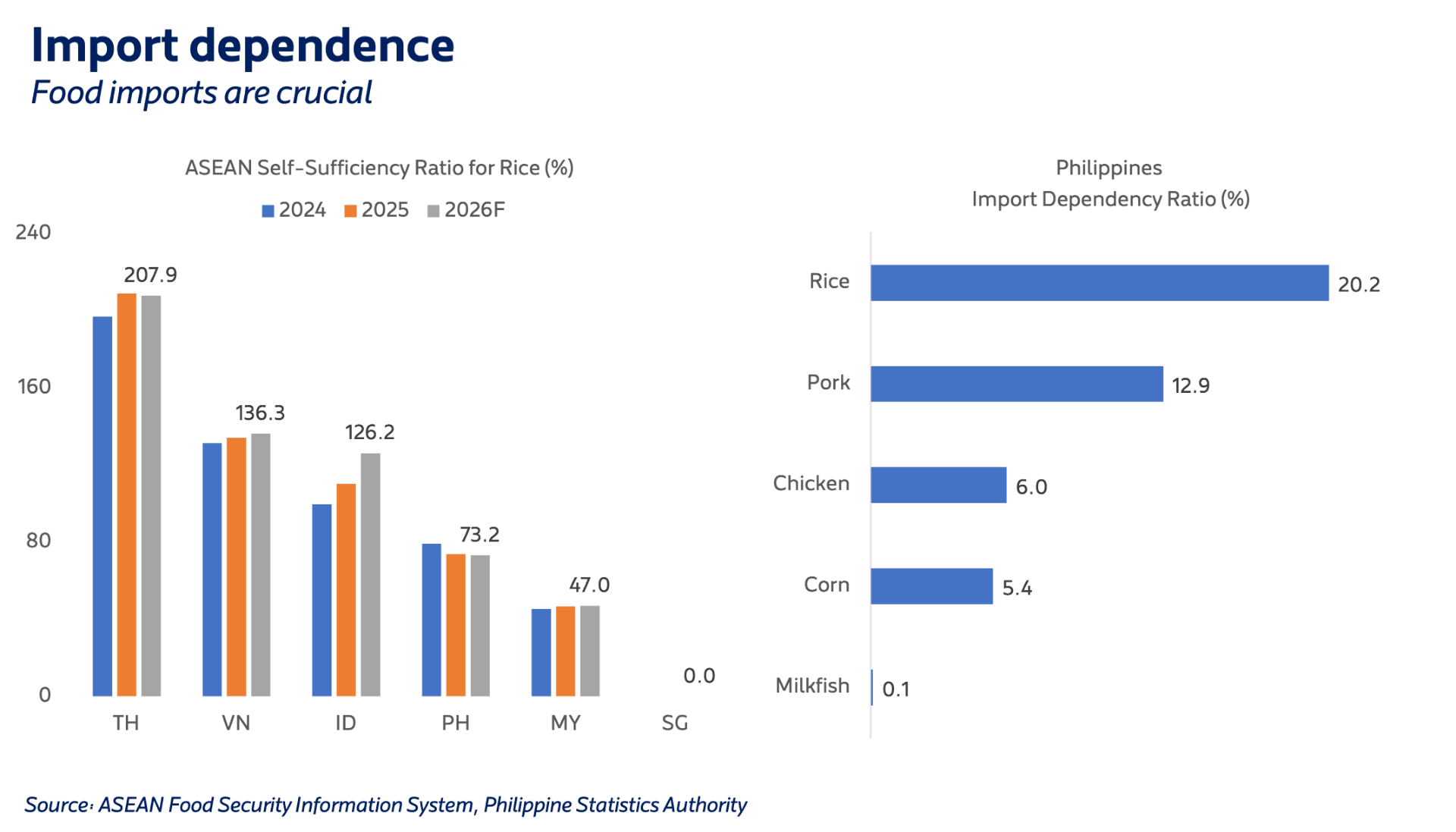
The country’s rice self-sufficiency ratio* is seen lower than most Southeast Asian peers, according to the ASEAN Food Security Information System. This is compounded by a dependence on imports for other food staples, including pork, chicken, and corn.

*Note: The Self-Sufficiency Ratio measures the extent to which a country can satisfy its own consumption needs through domestic production. The Import Dependency Ratio measures the extent to which a country relies on imports to meet its internal requirements for a specific commodity (latest data as of 2019 from the Philippine Statistics Authority).
Headline inflation is expected to remain elevated. Following a 4.1% print in March, the Bangko Sentral ng Pilipinas (BSP) expects inflation to be elevated for most of the year, driven by supply-side pressure. Metrobank forecasts inflation at 5.3% for the full-year 2026 before easing to 3.0% in 2027.
Related Article: BSP Update: BSP U-turn on oil surge
In this current environment, market sentiment will be dictated by geopolitical developments.
Investors are recommended to adopt a selective approach, as persistent inflationary pressure may compel the BSP to continue with monetary policy tightening this year.
An elevated policy rate is expected to keep bond yields elevated, while local stock prices will likely remain rangebound in the near term, as markets price in higher cost of capital. Nevertheless, a hawkish BSP stance may provide fundamental support for the peso.
For updates and more insights on the US-Iran conflict’s impact on assets, visit Wealth Insights’ analysis section.
SOPHIA THERESE “PIA” BONIFACIO is a Research Officer at Metrobank, covering local and offshore macroeconomic research. She obtained her Bachelor’s degree in Economics with a Specialization in Financial Economics, cum laude, from the Ateneo de Manila University and is a Certified UITF Sales Person (CUSP). Pia enjoys long road trips and is a self-proclaimed milk tea connoisseur.