Economy2 MIN READ

Metrobank US-Iran Risk Index: Framework of a deal

Market players may finally see some relief ahead, as the US and Iran finalize a framework for a deal.
May 29, 2026 by Metrobank, Investment Counselor Department
Share this article:
Featured Article Image

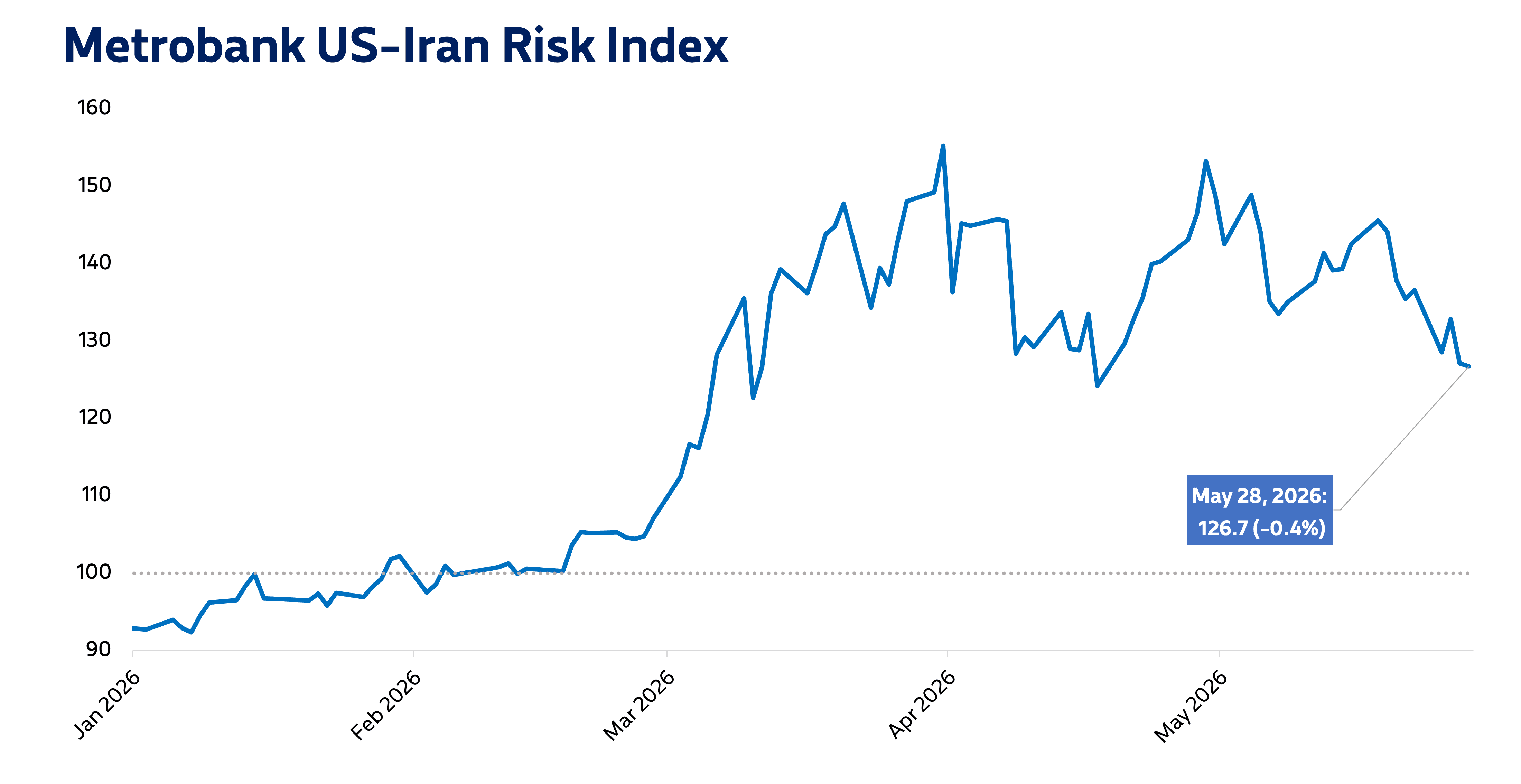
Metrobank’s US-Iran Risk Index settled at 126.7 on May 28th, 0.4% lower than the prior trading day.

Global oil prices edged lower as markets priced in news of a potential peace deal being finalized between the US and Iran. Al Jazeera reported that the tentative agreement includes provisions for an extended ceasefire, unrestricted navigation through the Strait of Hormuz—a key oil trading route, and the lifting of the US blockade.

Brent Crude closed at USD 93.71 per barrel on Thursday, UK trading, according to data compiled by Bloomberg.

The benchmark 10-year US Treasury yield moved lower by nearly 4 basis points on Thursday, US trading, on market players’ optimism for a deal.  

Meanwhile, the US dollar index pared its gains from the past two days, as peace deal hopes diverted flows away from the greenback. The dollar-peso exchange rate closed at 61.60 on Thursday, Philippine trading.

US President Donald Trump has reportedly yet to sign off on the deal, according to Al Jazeera. Thus, market players will likely still lean more risk-off until the deal gets approved. Reported military attacks between the two countries will also keep risk levels elevated in the meantime.

Metrobank still sees elevated risk and volatility in the near-term while a peace deal has not been approved. Oil prices are poised to stay high, as global supply remains constricted due to the war’s impact on Middle East oil facilities. Consequently, domestic inflation is expected to quicken in the coming months, which will put upward pressure on Philippine bond yields.  

Moreover, Metrobank forecasts continued rate hikes by the Bangko Sentral ng Pilipinas (BSP) this year to stem accelerating inflation. Finally, Metrobank expects the dollar-peso exchange rate to stay elevated, as dollar demand weighs on a weak peso. 

Metrobank’s US-Iran Risk Index measures the amount of risk that the ongoing conflict presents to financial markets. It considers the general risk sentiment of investors and inflationary pressure brought by the conflict. A value of 100 denotes a normal level of risk based on market levels prior to the conflict’s escalation, while values greater than 100 imply increasing levels of risk.

What now?

What now?
Category
Local Fixed Income
Outlook
Bearish
Strategy
Stay defensive within an average duration of 2 to 5 years, as foreign exchange-driven volatility, upcoming bond supply, and potentially more BSP rate hikes may keep the yield curve elevated. The 2- to 3-year yields have already returned to 2018 highs while 5-year trades flat to the back of the yield curve. Though aggressively adding positions is cautioned against, the rejection of bids near 8% at the Bureau of the Treasury’s 7-year auction last week may also discourage investors from bidding too defensively. 
Category
Local Equities
Outlook
Neutral
Strategy
Maintain a cautiously defensive outlook and lean toward banks, defensive names, and high-quality index stocks that could benefit from improved macroeconomic confidence. Stay nimble and consider pullbacks as bargain-hunting opportunities. 
Category
Global Fixed Income
Outlook
Bearish
Strategy
Maintain a slight underweight in duration, with focus on the 3- to 7-year segment, where carry remains compelling, while limiting exposure to further upside in yields. With US inflation tilting toward the upside, yields are likely to remain elevated, reinforcing a higher-for-longer rate environment. Near-term direction will continue to be shaped by geopolitical developments and inflation expectations.
Category
Global Equities
Outlook
Slightly Bullish
Strategy
Maintain a prudent allocation by focusing on sectors with stable earnings and attractive yields, while remaining selective in adding exposure to fundamentally strong companies amid market uncertainty. Elevated geopolitical risks continue to support energy prices through a higher risk premium, which may limit upside potential for global equities in the near term.
Category
USD/PHP
Outlook
Neutral
Strategy
Maintain a neutral to mildly bearish stance, with price action expected to remain contained within the 61.40-61.80 range, as repeated rejection near 61.75 continues to cap rallies. Favor fading strength into resistance while selectively building positions on dips. The balanced flows and moderating momentum reinforce consolidation, with mixed macroeconomic signals—softening US sentiment and persistent geopolitical risk—keeping the pair range-bound, with a slight downside bias. 
Category
G10 Currencies / US Dollar
Outlook
Bearish
Strategy
G10 should remain tactically bearish, as USD support from elevated US yields and a higher-for-longer US Federal Reserve (Fed) policy rate outweigh the recent relief from improving risk sentiment and falling oil prices. While near-term rebounds in the EUR, GBP, and other G10 currencies may occur due to the stretched USD positioning, these are likely to be corrective and may be used as opportunities to sell rallies rather than chase upside.    
Category
Gold
Outlook
Slightly Bullish
Strategy
Gold hovers around USD 4,500, following news of a US-Iran peace deal taking shape. Though Brent Crude has dropped below USD 100, the Fed remains hawkish on continued inflationary pressure. Gold will likely remain sluggish until a firm US-Iran agreement is firmly in place. Meanwhile, headlines continue to drive swings. The long-term bullish view on gold remains constructive, with current levels seen as a good accumulation opportunity. 
(Disclaimer: This is general investment information only and does not constitute an offer or guarantee, with all investment decisions made at your own risk. The bank takes no responsibility for any potential losses.)
Read More Articles About: