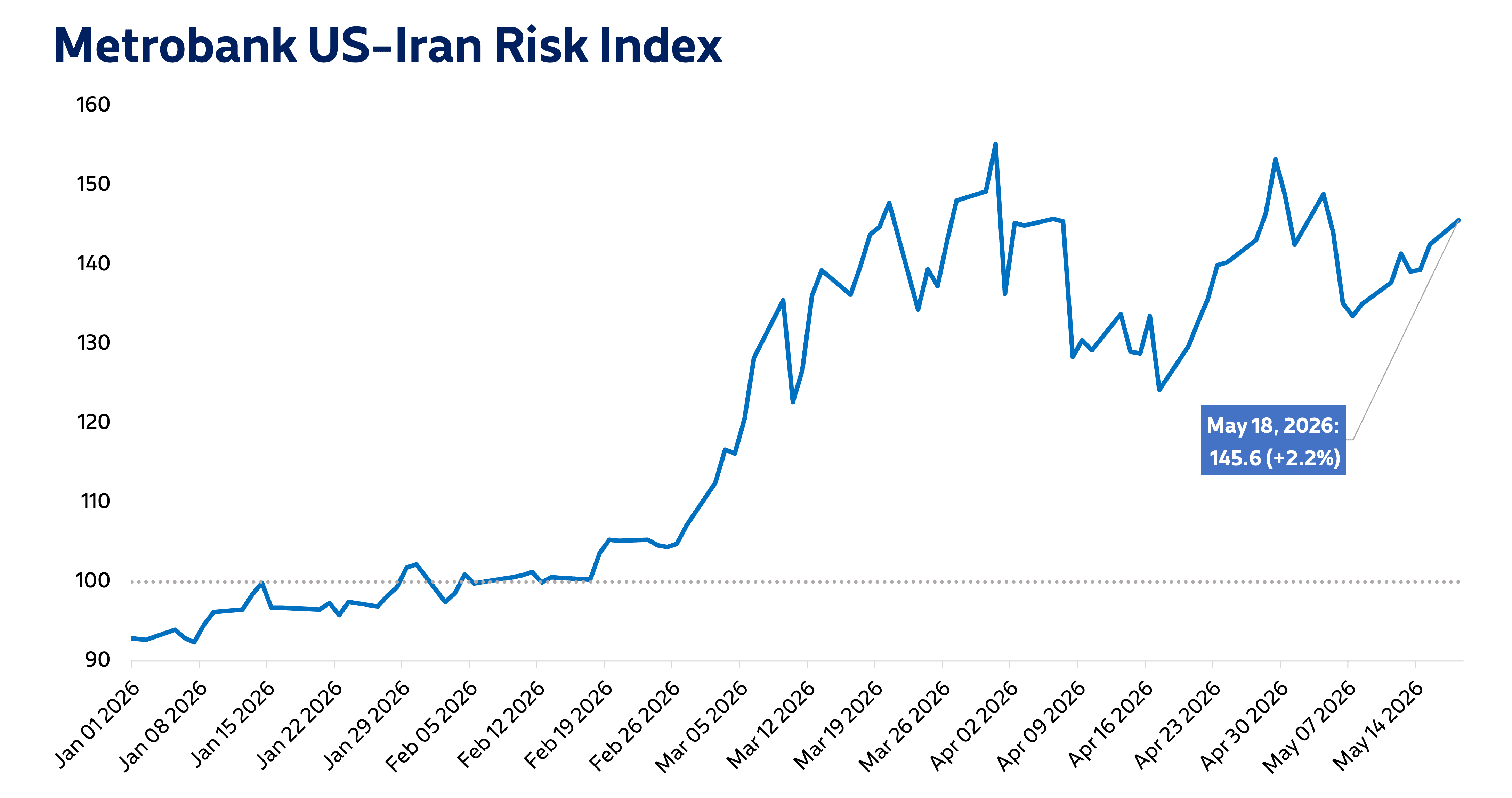
Metrobank’s US-Iran Risk Index settled at 145.6 on May 18th, 2.2% higher than the prior trading day.
Global oil prices rose, as the Strait of Hormuz's closure and potential military escalation continued to stoke supply concerns. Brent crude closed at USD 112 per barrel on Monday, UK trading, according to data compiled by Bloomberg.
Oil prices eased slightly in early Tuesday trade, following news that US President Donald Trump called off a military attack on Iran at the request of Gulf allies, according to Al Jazeera. It was also reported that negotiations were underway after stalled progress on talks.
Despite providing some relief, financial market players are expected to remain risk-off until concrete progress is made toward a peace truce.
The benchmark 10-year US Treasury yield was little changed on Monday, US trading, after reaching a one-year high last week. Market players continue to digest the current US inflation outlook and the US Federal Reserve's (Fed) regime change.
Meanwhile, the US dollar index softened on Monday, though the greenback still maintained its strength against a fundamentally weak peso. The dollar-peso exchange rate recorded a new all-time high closing price of 61.75 on Monday, Philippine time.
Metrobank still sees elevated risk and volatility in the near-term while a peace deal has not been struck. Oil prices are poised to stay high, as global supply remains constricted due to the war’s impact on Middle East oil facilities. Consequently, domestic inflation is expected to quicken in the coming months.
Moreover, Metrobank forecasts continued rate hikes by the Bangko Sentral ng Pilipinas (BSP) this year to stem accelerating inflation. Finally, Metrobank expects the dollar-peso exchange rate to stay elevated, as dollar demand weighs on a weak peso.