Economy2 MIN READ

Metrobank US-Iran Risk Index: The clock is ticking

Risk levels will likely remain elevated in financial markets this week, following reports that Trump said time may be running out for US-Iran peace talks.
May 18, 2026 by Metrobank, Investment Counselor Department
Share this article:
Featured Article Image

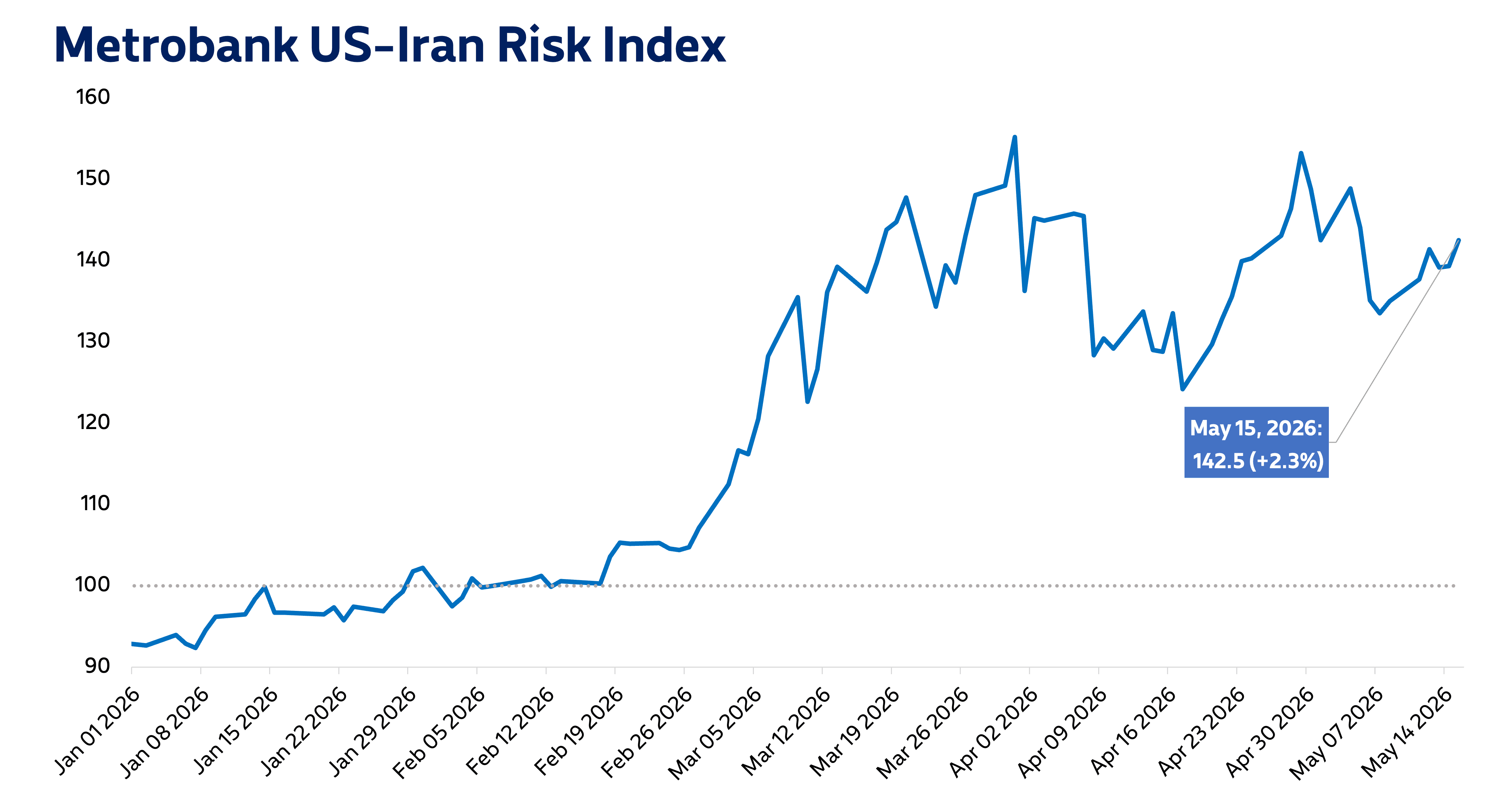
Metrobank’s US-Iran Risk Index settled at 142.5 on May 15th, 2.2% higher than the prior trading day.

Oil prices continued to rise, as the stalled US-Iran talks left market players with little hope for the Strait of Hormuz's swift reopening. This comes after US President Donald Trump’s Beijing trip last week, where he discussed the need to open the strait with Chinese President Xi Jinping, according to Reuters. Brent Crude closed higher at USD 109 per barrel on Friday, UK trading, according to data compiled by Bloomberg.

Meanwhile, the benchmark 10-year US Treasury yield rose by more than 11 basis points on Friday, US trading, as accelerating inflation data weighed on yields. According to Reuters, the 10-year note posted its highest yield in nearly a year last week.

The US dollar index gained on safe-haven flows. On the domestic side, corporate demand pushed the US dollar upward relative to the peso, leading to the dollar-peso exchange rate recording an all-time high close of 61.72 on Friday, Philippine time.

Over the weekend, Trump warned Iran that the “clock is ticking” for the two countries to agree to a peace deal, according to the BBC. With the threat of military escalation looming, risk levels will be tipped to the upside this week, as market players monitor developments in the war.

Metrobank still sees elevated risk and volatility in the near-term while a peace deal has not been struck. Oil prices are poised to stay high, as global supply remains constricted due to the war’s impact on Middle East oil facilities. Consequently, domestic inflation is expected to quicken in the coming months.  

Moreover, Metrobank forecasts continued rate hikes by the Bangko Sentral ng Pilipinas (BSP) this year to stem accelerating inflation. Finally, Metrobank expects the dollar-peso exchange rate to stay elevated, as dollar demand weighs on a weak peso. 

Metrobank’s US-Iran Risk Index measures the amount of risk that the ongoing conflict presents to financial markets. It considers the general risk sentiment of investors and inflationary pressure brought by the conflict. A value of 100 denotes a normal level of risk based on market levels prior to the conflict’s escalation, while values greater than 100 imply increasing levels of risk.

What now?

What now?
Category
Local Fixed Income
Outlook
Bearish
Strategy
Stay defensive in the 2- to 5‑year sector as foreign exchange-driven volatility, upcoming bond supply, and potentially more BSP rate hikes may steepen the yield curve. 3- to 5-year bonds have already returned to 2019 highs, but adding positions aggressively may not be advisable given the unsupportive economic environment. 
Category
Local Equities
Outlook
Neutral
Strategy
Maintain a cautiously defensive outlook and lean toward banks, defensive names, and high-quality index stocks that could benefit from improved macroeconomic confidence. Stay nimble and consider pullbacks as bargain-hunting opportunities.
Category
Global Fixed Income
Outlook
Bearish
Strategy
Maintain a slight underweight in duration, with focus on the 3- to 7-year segment, where carry remains compelling, while limiting exposure to further upside in yields. With US inflation titling toward the upside, yields are likely to remain elevated, reinforcing a higher-for-longer rate environment. Although, near-term direction will continue to be shaped by geopolitical developments and inflation expectations.
Category
Global Equities
Outlook
Neutral
Strategy
Maintain a cautious stance by prioritizing high-yielding and defensive sectors, while selectively allocating to strong growth companies despite continued market volatility. Heightened geopolitical tensions drive prices higher through an increased risk premium in energy markets, which could continue to cap meaningful gains in global equities.
Category
USD/PHP
Outlook
Mildly Bullish
Strategy
USD/PHP strategy remains range-bound with a slight USD-positive bias, as strong dollar fundamentals and steady corporate demand continue to support the pair, particularly on dips. However, the upside remains capped near the 61.75–62.00 resistance zone due to strong supply and positioning. The pair is likely to remain driven by external USD flows rather than domestic catalysts, reinforcing a tactical trading approach. 
Category
G10 Currencies / US Dollar
Outlook
Bearish
Strategy
The strategy for G10 versus USD remains tactical and defensive, as persistent US inflation, rising yields, and a stronger USD trend continue to cap the upside in major currencies. While some pairs may attempt short-term rebounds due to oversold conditions, the broader macroeconomic backdrop still favors USD strength. This suggests that rallies in EUR, GBP, and other G10 currencies should fade. Positioning should focus on selling rallies rather than chasing downside, given the risk of consolidation after an extended USD move.
Category
Gold
Outlook
Mildly Bearish
Strategy
Gold broke below initial support levels, re-establishing stability around 4,500, as rising oil prices and a hawkish US Federal Reserve puts pressure on non-interest-bearing assets such as metals. News headlines around the escalation US-Iran drive near-term bearishness, though the long-term bullish view on gold remains intact.
(Disclaimer: This is general investment information only and does not constitute an offer or guarantee, with all investment decisions made at your own risk. The bank takes no responsibility for any potential losses.)
Read More Articles About: