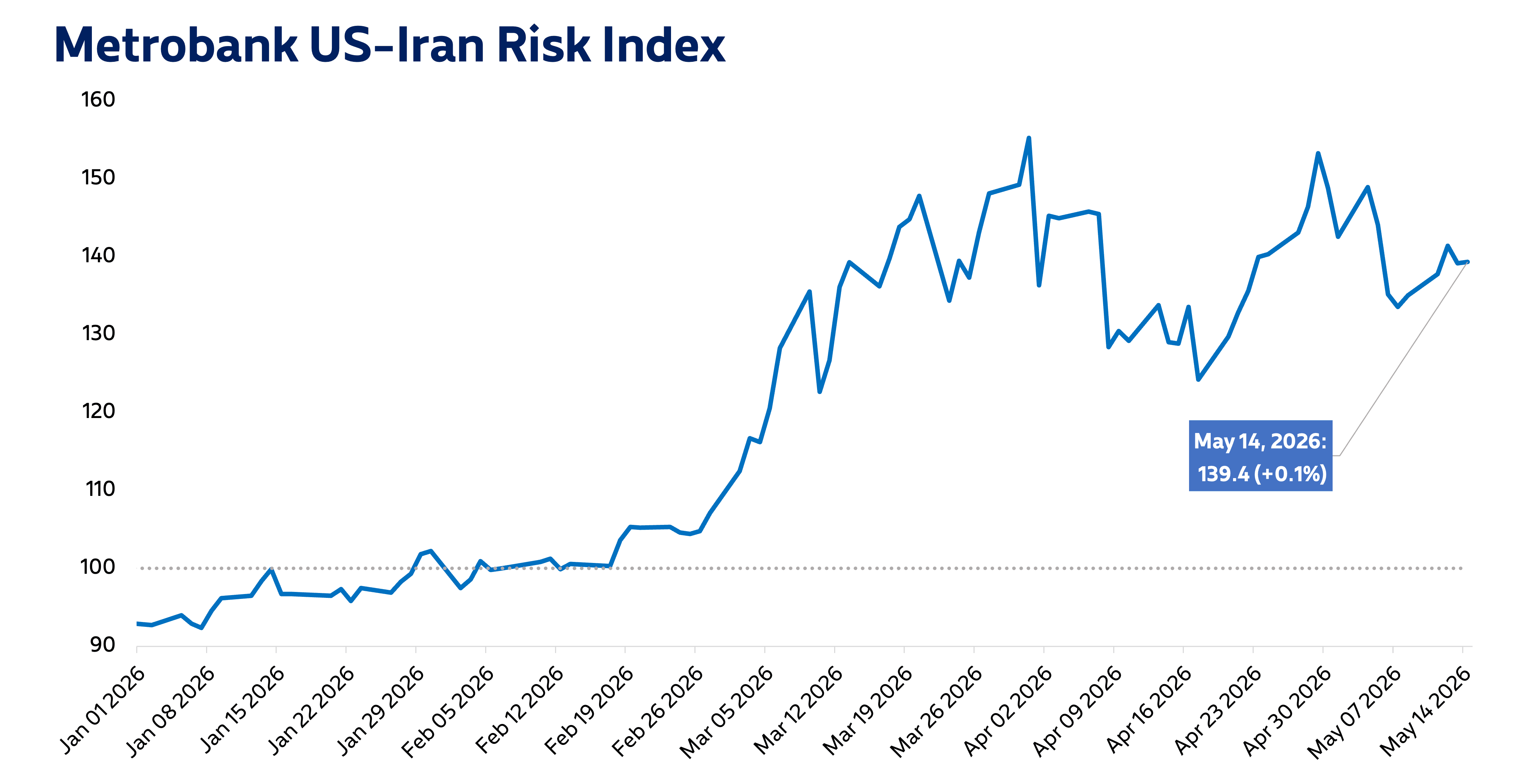
Metrobank’s US-Iran Risk Index settled at 139.4 on May 14th, 0.1% higher than its value of 139.2 on the prior trading day.
Oil prices were flat, as market players priced in news that several vessels were able to cross the Strait of Hormuz on Thursday, though attacks and seizures of some ships kept supply concerns afloat, according to Reuters. Brent Crude closed at USD 105.7 per barrel during UK trading, according to data compiled by Bloomberg.
Moreover, the benchmark 10-year US Treasury yield notched higher by more than 1 basis point, as US inflation data stoke price-rise expectations.
Meanwhile, the US dollar index posted further gains, due to safe-haven flows and cooling expectations for an immediate rate cut by the US Federal Reserve, given recent US inflation data. The dollar-peso exchange rate closed at 61.64 on Thursday, Philippine trading.
Currently, US-Iran negotiations remain at an impasse. Ongoing talks between US President Donald Trump and China's President Xi Jinping will be monitored by market players for potential signals on the direction of the conflict. Expect market players to remain risk-off in the meantime, as they await more concrete developments.
Metrobank still sees elevated risk and volatility in the near-term while a peace deal has not been struck. Oil prices are poised to stay high, as global supply remains constricted due to the war’s impact on Middle East oil facilities. Consequently, domestic inflation is expected to quicken in the coming months.
Moreover, Metrobank forecasts at least one more rate hike by the Bangko Sentral ng Pilipinas (BSP) this year to stem accelerating inflation. Finally, Metrobank expects the dollar-peso exchange rate to stay elevated, as dollar demand weighs on a weak peso.