


Economy2 MIN READ
Metrobank US-Iran Risk Index: Reaching a deal
Risk levels in financial markets dropped, as the US and Iran reach a peace deal.
June 16, 2026 by Metrobank Research, Investment Counselor Department
Share this article:

Metrobank’s US-Iran Risk Index settled at 115.4 on June 10, down by 3.8% from 120.0 the prior trading day. This is also the risk index’s lowest level since March.
The US and Iran reached an initial deal to end the war on Sunday, according to Al Jazeera. The deal—which includes an end to military hostilities and the complete reopening of the Strait of Hormuz, a critical passage for international oil shipments—is set to be signed on Friday, the news agency reported.
Global oil prices dropped following news of the deal, as concerns over oil supply eased. Brent crude futures settled lower at USD 83 per barrel on Monday, UK trading, according to data compiled by Bloomberg.
Moreover, the US dollar weakened, with flows moving away from the safe-haven currency as market players turned more risk-on. The dollar-peso exchange rate closed below the 61-level for the first time in several weeks on Monday, Philippine trading. The 10-year US Treasury yield also moved lower during US trading on lower inflation expectations and a less hawkish outlook for the US Federal Reserve (Fed).
While market players saw greater relief with the deal, some risks remain. Israel Prime Minister Benjamin Netanyahu said that they will keep troops in Lebanon despite the end to military hostilities, according to Al Jazeera. Moreover, the US and Iran will still engage in nuclear negotiations in the coming weeks. US President Donald Trump said the US may resume military attacks if talks turn sour, according to CNN.
Though oil prices have softened in the past few days, Metrobank still sees full-year inflation in the Philippines exceeding the Bangko Sentral ng Pilipinas (BSP)’s target this year, which will place upward pressure on Philippine bond yields.
Moreover, Metrobank expects the BSP to remain hawkish this year. Finally, Metrobank forecasts the dollar-peso exchange rate to stay elevated, as corporate demand for the dollar picks up in the coming months.
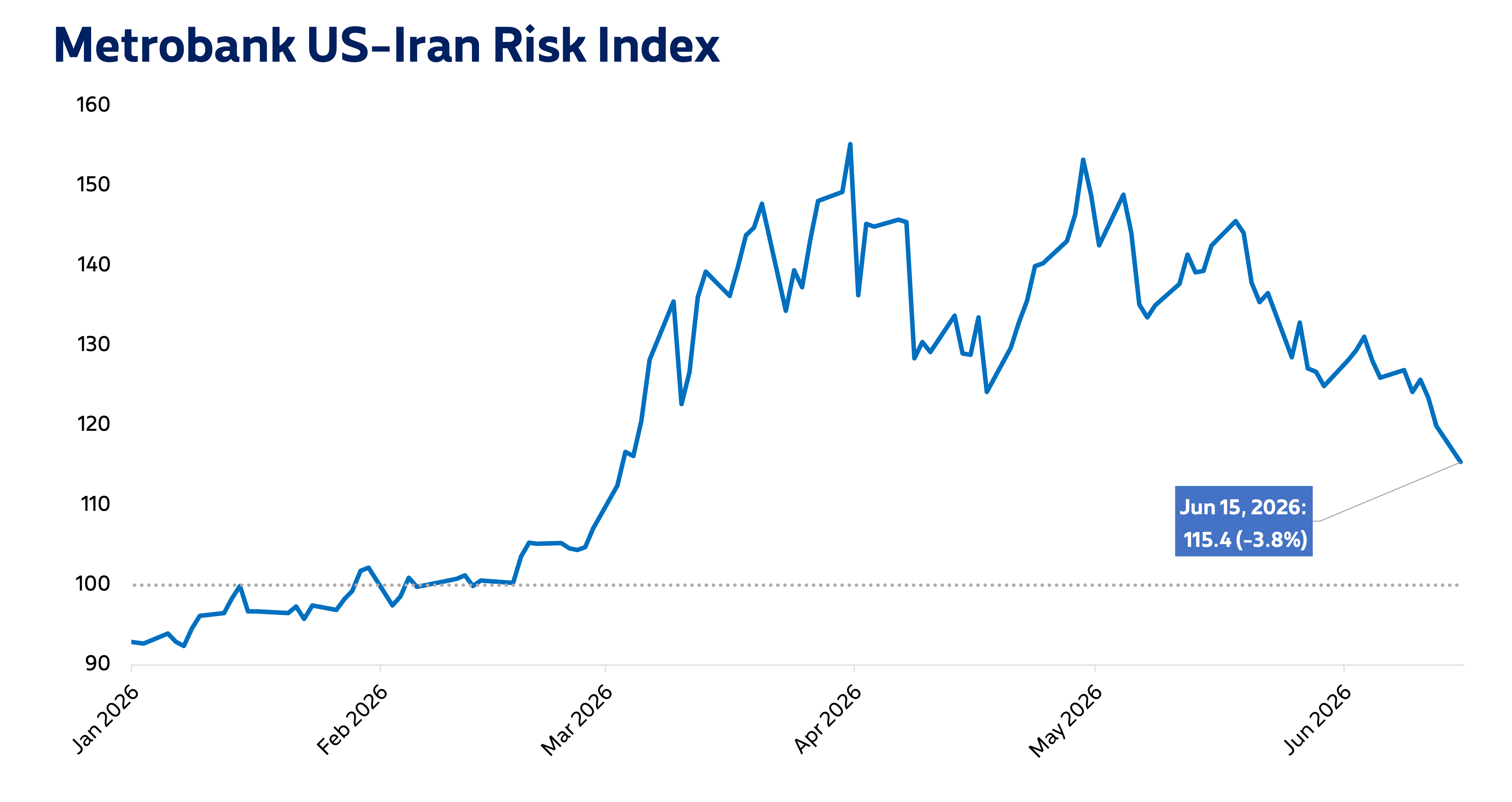
Metrobank’s US-Iran Risk Index measures the amount of risk that the ongoing conflict presents to financial markets. It considers the general risk sentiment of investors and inflationary pressure brought by the conflict. A value of 100 denotes a normal level of risk based on market levels prior to the conflict’s escalation, while values greater than 100 imply increasing levels of risk.
As the tensions in the Middle East ease, Metrobank will only publish its US-Iran Index as the need arises. For more, economic and investment insights explore our analysis and wealthy living pages. If you are already a client, you may also reach out to your Wealth Specialist.