Economy2 MIN READ

Metrobank US-Iran Risk Index: On shaky ground

Military escalation between Israel and Iran and a lack of progress toward a peace deal tilt risk levels in financial markets to the upside.
June 9, 2026 by Metrobank Research, Investment Counselor Department
Share this article:
Featured Article Image

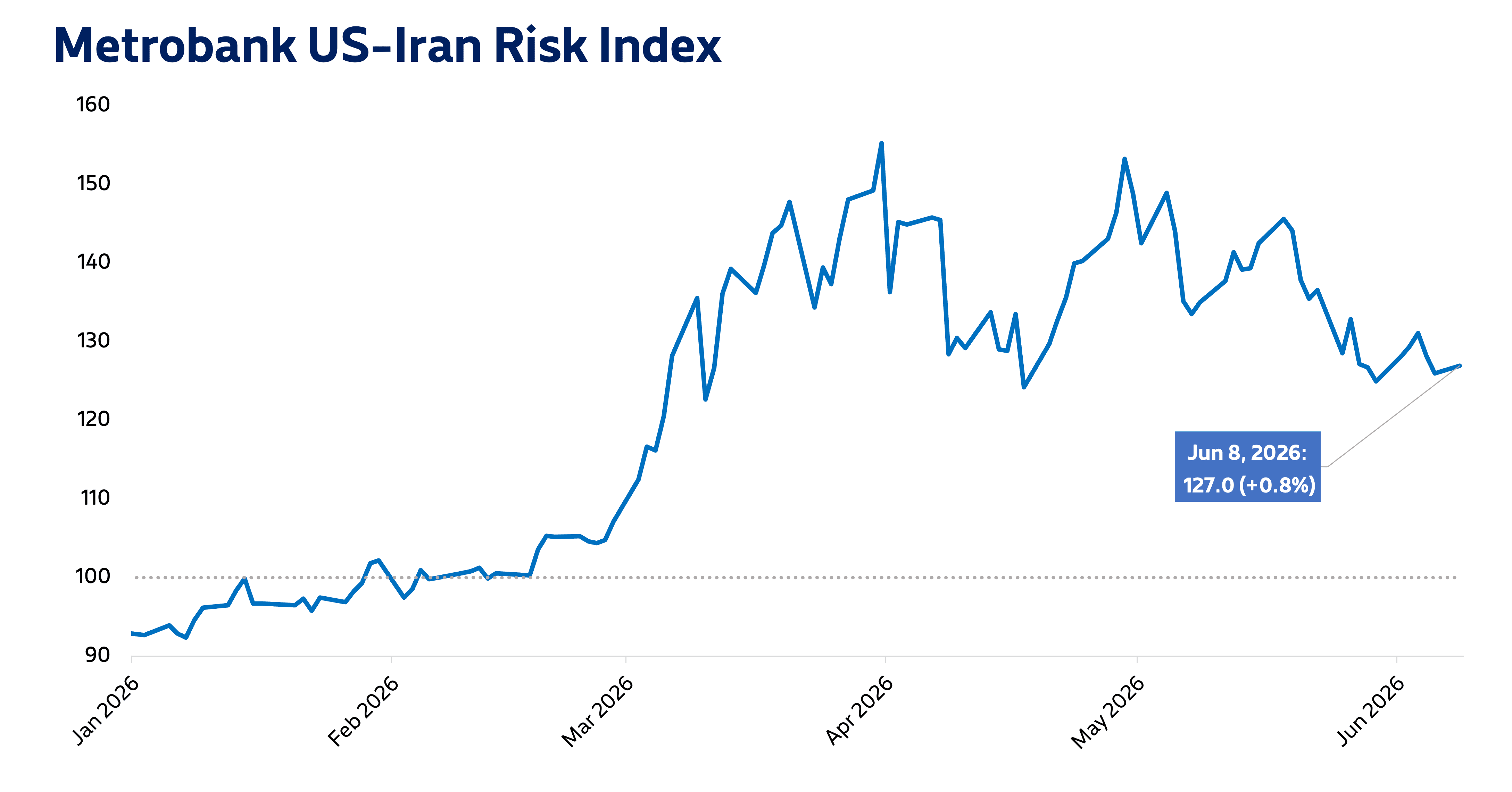
Metrobank’s US-Iran Risk Index settled at 127.0 on June 8, up by 0.8% from 126.0 the prior trading day.

Global oil prices rose as much as 5% during early UK trade on Monday, as Israel and Iran exchanged military strikes, according to Reuters. The commodity eventually pared most of these gains later in the day, as the two countries agreed to halt attacks. Brent crude futures still settled higher compared to the previous trading day at USD 94.25 per barrel, according to data compiled by Bloomberg.

Meanwhile, the benchmark 10-year US Treasury yield climbed by 3 basis points, as market players reacted to Israel-Iran hostilities and a more hawkish outlook for the US Federal Reserve. Meanwhile, the US dollar index was steady on Monday, with the dollar-peso exchange rate closing at 61.69 during Philippine trading.

While market players appear to price lower levels of risk compared to the onset of the war, the lack of a concrete peace deal and continued military attacks keep risks elevated.  

Metrobank sees elevated risk and volatility in the near-term, given the lack of progress in US-Iran negotiations. Oil prices are poised to stay high, as global supply remains constricted due to the war’s impact on Middle East oil facilities. Domestic inflation is expected to exceed the Bangko Sentral ng Pilipinas (BSP)’s target this year, which will put upward pressure on Philippine bond yields.  

Moreover, Metrobank forecasts continued rate hikes by the BSP this year to stem accelerating inflation. Finally, Metrobank expects the dollar-peso exchange rate to stay elevated, as dollar demand weighs on a weak peso. 

Metrobank’s US-Iran Risk Index measures the amount of risk that the ongoing conflict presents to financial markets. It considers the general risk sentiment of investors and inflationary pressure brought by the conflict. A value of 100 denotes a normal level of risk based on market levels prior to the conflict’s escalation, while values greater than 100 imply increasing levels of risk.

What now?

What now?
Category
Local Fixed Income
Outlook
Bearish
Strategy
Stay defensive within an average duration of 2 to 5 years, as foreign exchange-driven volatility, upcoming bond supply, and potentially more BSP rate hikes may keep the yield curve elevated. This area of the yield curve has been trading at highs last seen in 2019, the 5-year yield still trades flat to longer-dated bonds. This week’s 3-year and 8-year bond auctions may also add upward pressure on yields should market participants start bidding defensively again. 
Category
Local Equities
Outlook
Slightly Bullish
Strategy
Maintain a cautiously defensive stance but with a more constructive tilt after a slower-than-expected Philippine inflation print. Favor banks and defensive high-quality names in the utilities and services sectors that may benefit from strengthening macroeconomic confidence and a more accommodative BSP policy path. Stay nimble and view pullbacks as attractive opportunities to build positions.
Category
Global Fixed Income
Outlook
Bearish
Strategy
Stay cautious with duration in the near term, favoring a 2- to 5-year positioning, as resilient US labor data and persistent inflation risks reinforce expectations of a higher-for-longer US Federal Reserve (Fed) policy-rate stance. The recent backup in US Treasury yields, led by the front-end, suggests continued sensitivity to policy repricing, particularly in the belly of the curve. While yields are becoming more attractive at the long-end, volatility and further upside risks may limit immediate entry.  
Category
Global Equities
Outlook
Slightly Bullish
Strategy
Maintain a prudent allocation by focusing on sectors with stable earnings and attractive yields, while remaining selective in adding exposure to fundamentally strong growth companies amid ongoing market uncertainty. Elevated geopolitical risks continue to support energy prices through a higher risk premium, which may limit upside potential for global equities in the near term. 
Category
USD/PHP
Outlook
Neutral
Strategy
Maintain a neutral to mildly bullish USD stance. Expect early-week USD demand, but an upside may remain capped near 61.75, where repeated rejection and sizeable supply limit follow-through. Favor buying USD on dips toward 61.30-61.50 and fading strength near 61.70, as balanced flows, opportunistic supply, and ongoing geopolitical risks continue to support consolidation rather than a sustained breakout. 
Category
G10 Currencies / US Dollar
Outlook
Bearish
Strategy
Position for continued USD strength, as strong US jobs data, elevated geopolitical risks and higher oil prices create the higher-for-longer Fed policy that may be supportive of the dollar. While G10 currencies may see short-term rebounds due to positioning or risk sentiment swings, these are likely to remain corrective rather than trend-reversing, especially given persistent yield differentials. Focus on selling rallies while being mindful of volatility, as financial markets remain driven by news headlines. 
Category
Gold
Outlook
Slightly Bearish
Strategy
Gold fell to a two-month low on early Monday trading, breaching technical supports and threatening further dips, as strong US labor and economic data raised bets for a Fed policy rate hike. Nonetheless, fundamental drivers are supportive of a long-term positive outlook, with current levels possibly seen as good entry opportunities for strategic investors.
(Disclaimer: This is general investment information only and does not constitute an offer or guarantee, with all investment decisions made at your own risk. The bank takes no responsibility for any potential losses.)
Read More Articles About: