Economy2 MIN READ

Metrobank US-Iran Risk Index: Risk rises on attacks

Financial-market risk levels reach a multi-week high amid new attacks between the US and Iran.
July 20, 2026 by Metrobank Research, Investment Counselor Department
Share this article:
Featured Article Image

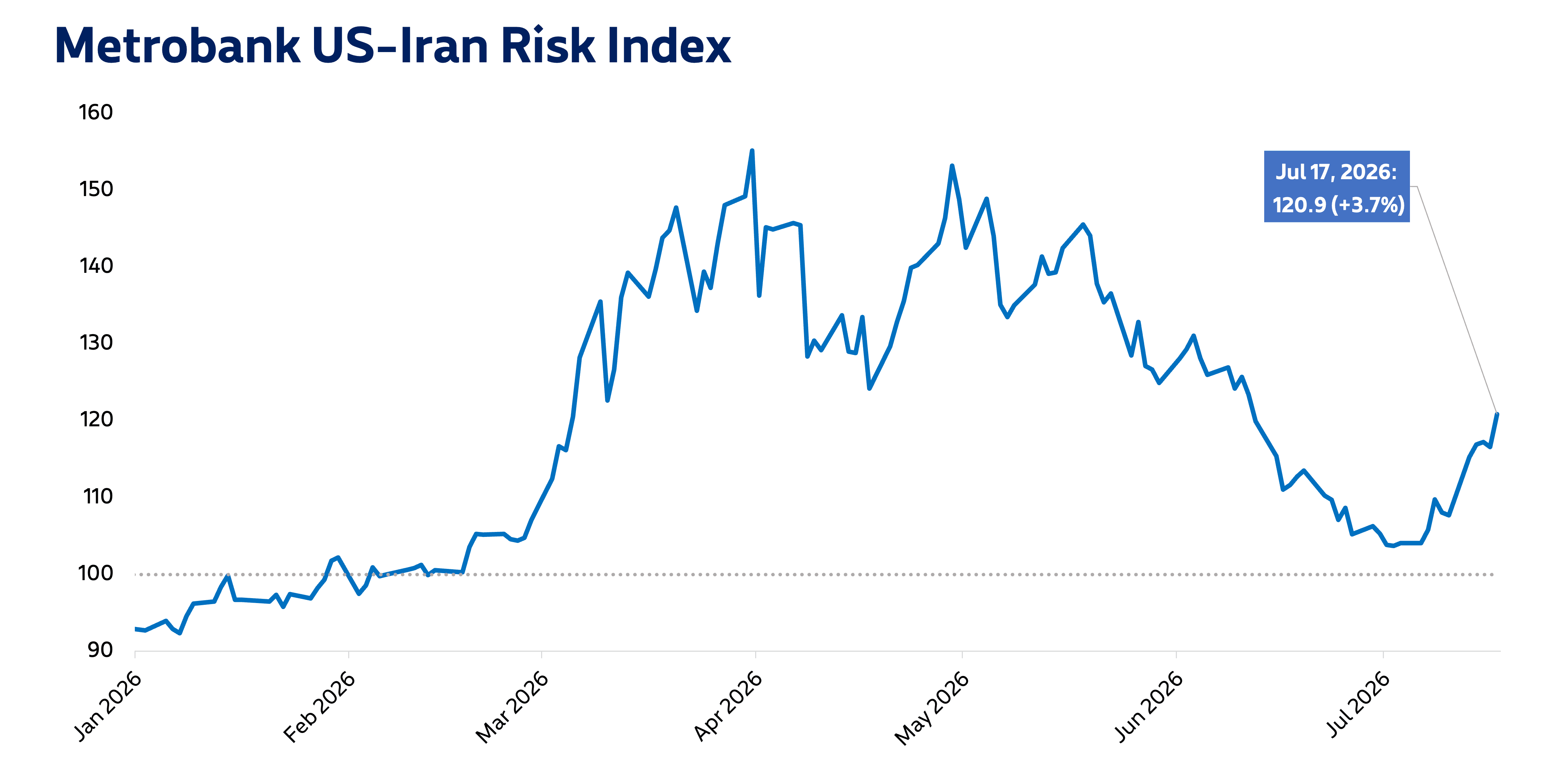
Metrobank’s US-Iran Risk Index settled at 120.9 on July 17, 3.7% higher than its value of 116.6 the day prior. This is the risk index’s highest reading in over a month, mirroring market risk levels prior to the initial Memorandum of Understanding proposed in June.

Global oil prices reached multi-week highs, as both the US and Iran intensified military attacks on key infrastructure in the Middle East, according to Reuters. Continued tensions along the Strait of Hormuz, a critical passage for global oil shipments, added pressure. Brent crude closed higher at USD 88 per barrel on Friday, UK trading, according to data compiled by Bloomberg.

While the benchmark 10-year US Treasury yield fell despite fresh attacks, the 2-year US Treasury yield rose, as market players maintained a more hawkish rate outlook for the US Federal Reserve (Fed) due to inflationary pressure.  

Meanwhile, the US dollar preserved its strength, with the dollar-peso exchange rate closing Friday at 61.59 during Philippine trading.

Brent crude pushed past the USD 90-level per barrel on early Monday trading. With both the US and Iran signaling intensified military attacks, oil prices may further rise in the near term, fanning both inflation expectations and financial market risk levels.

Domestically, Metrobank sees still elevated inflation this year, pressuring Philippine bond yields and keeping the Bangko Sentral ng Pilipinas hawkish.  

Finally, Metrobank forecasts the dollar-peso exchange rate to stay elevated amid a hawkish Fed and corporate demand.

Metrobank’s US-Iran Risk Index measures the amount of risk that the ongoing conflict presents to financial markets. It considers the general risk sentiment of investors and inflationary pressure brought by the conflict. A value of 100 denotes a normal level of risk based on market levels prior to the conflict’s escalation, while values greater than 100 imply increasing levels of risk.  

What now?

What now?
Category
Local Fixed Income
Outlook
Slightly Bearish
Strategy
It may be favorable to keep a defensive positioning at the front end of the peso yield curve, with opportunistic entry at elevated yields at the belly. Consider lightening position at the back end. It may be advisable to remain underweight in overall duration amid geopolitical headwinds.
Category
Local Equities
Outlook
Moderately Bullish
Strategy
Financials and services may be preferred on resilient domestic demand, improving foreign participation, and expectations of supportive second-quarter earnings. Stay selective in fundamentally strong market leaders with clear earnings visibility and robust balance sheets. Near-term weakness may be an opportunity to accumulate quality names while positioning a potential advance of the Philippine Stock Exchange index (PSEi) toward the 6,450-6,500 range. 
Category
Global Fixed Income
Outlook
Slightly Bearish
Strategy
Consider being selective in quality credit while favoring the 2–7-year segment of the curve, where returns remain attractive relative to longer tenors. Moderating inflation expectations may provide support for bonds. Although resilient US growth, a higher-for-longer Fed rate narrative, and re-escalation of conflict in the Middle East may contribute to potential re-steepening of the yield curve.
Category
Global Equities
Outlook
Slightly Bearish
Strategy
A cautiously constructive stance on global equities may be kept, as the recent selloff in AI- and semiconductor-related stocks appears driven primarily by valuation resets and profit-taking rather than weakening fundamentals. While longer-term AI growth prospects remain intact, near-term sentiment may remain volatile amid concerns over AI spending, rising energy prices, and renewed geopolitical tensions. Investors should stay selective, favoring high-quality companies with strong earnings visibility and resilient balance sheets. 
Category
USD/PHP
Outlook
Neutral to Mildly Bullish USD
Strategy
The USD/PHP may remain rangebound this week, with heightened Middle East tensions and safe-haven demand for the dollar possibly reinforcing support around 61.15–61.40. Persistent offers near 61.75 may cap an upside. Consider favoring buying dips toward 61.15–61.40 and selling around 61.65–61.75, as mid-month corporate demand may strengthen the dollar but may not rapidly push up USD/PHP spot unless a larger deterioration in risk sentiment occurs. 
Category
G10 Currencies / US Dollar
Outlook
Neutral to Mildly Bullish USD
Strategy
G10 vs USD is broadly neutral with a slight USD bias, as performance across currencies stays uneven. While softer US inflation has capped the USD’s upside, renewed geopolitical tensions and rising oil prices reinforce safe-haven demand. Combined with its yield advantage, this may keep the USD supported and may limit sustained upside in G10 currencies. 
Category
Gold
Outlook
Neutral to Slightly Bearish
Strategy
Following renewed US-Iran tensions and hawkish Fed minutes, gold may trade neutral to slightly bearish in the near term. While geopolitical risks may support safe-haven demand, rising US Treasury yields and a stronger dollar may continue to weigh on gold prices. Unless tensions escalate further, an upside may remain limited, as markets focus on the higher-for-longer interest rate outlook.  
(Disclaimer: This is general investment information only and does not constitute an offer or guarantee, with all investment decisions made at your own risk. The bank takes no responsibility for any potential losses.)
Read More Articles About: