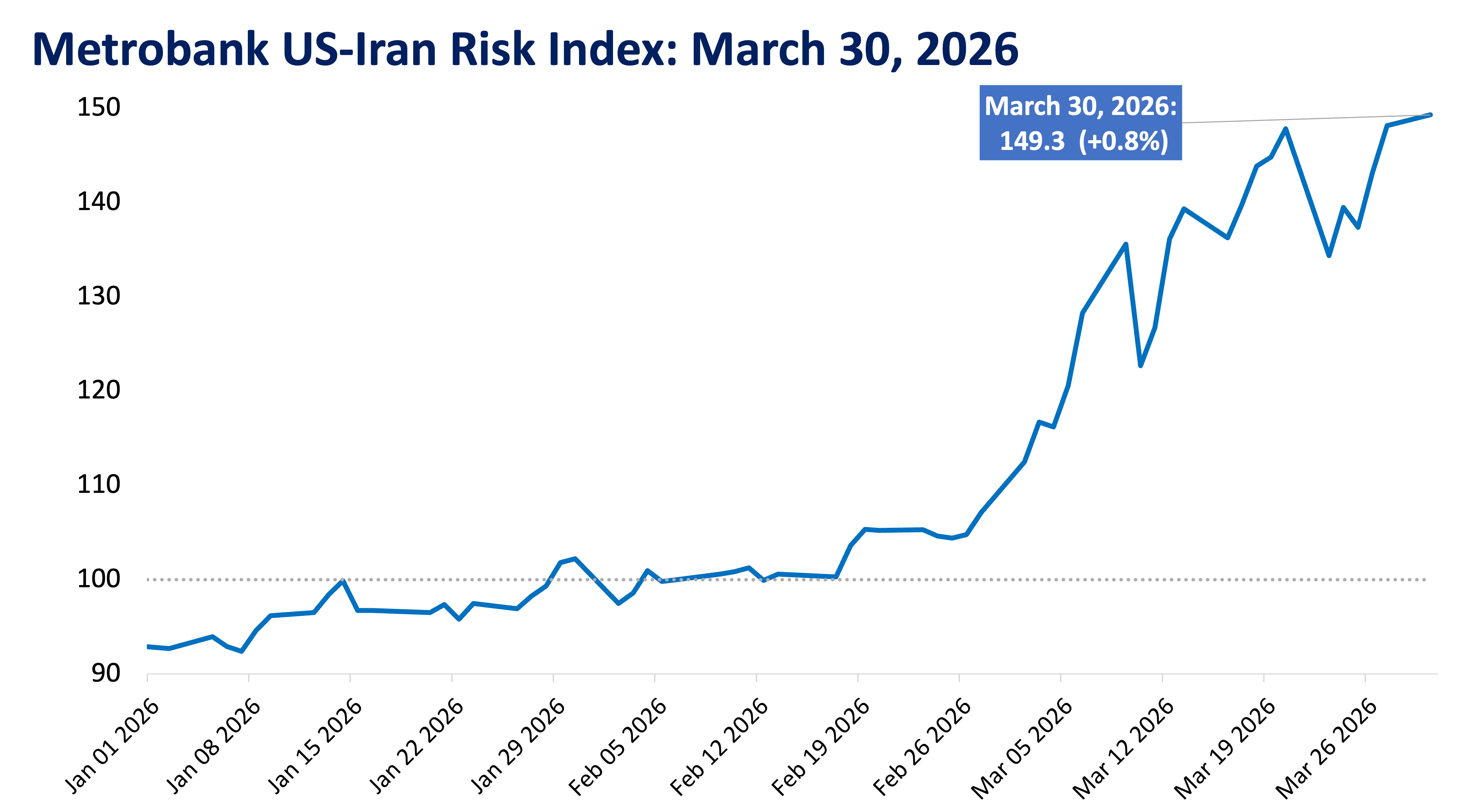
Metrobank’s US-Iran Risk Index settled at 149.3 on March 30, 2026, 0.8% higher than Friday’s. This marks another all-time high for the index.
The rise in risk levels stems from further gains in oil prices, as financial market players continue to see high uncertainty in the Middle East following the US’s deployment of thousands of troops in the area.
According to Reuters, the troops may be used to seize Kharg Island, one of Iran’s largest oil terminals, adding further risk to Middle East oil supply. Brent crude prices closed 0.2% higher on Monday as a result.
Moreover, the US dollar sustained its strength, with investors continuing to flock to the safe-haven asset as further Middle East escalations dimmed hopes for a ceasefire in the area. As a result, the dollar-peso exchange rate recorded another record high close on Monday during Philippine trading hours at 60.69.
Meanwhile, the benchmark 10-year US Treasury yield saw some relief as US Federal Reserve Chair Jerome Powell said that inflation expectations were grounded despite rising energy prices. He also said the current US policy interest rate was “a good place” to observe the impacts of the US-Iran conflict, according to CNBC, quelling market fears of interest rate hikes by the central bank in the near future.
Metrobank still sees continued upside oil risk as the Strait of Hormuz, a critical transit point for global oil shipments, remains closed. We also expect the Bangko Sentral ng Pilipinas to raise its policy rate this year to combat rising inflation. Lastly, we see the dollar-peso remaining elevated as the dollar continues to strengthen on safe-haven demand.