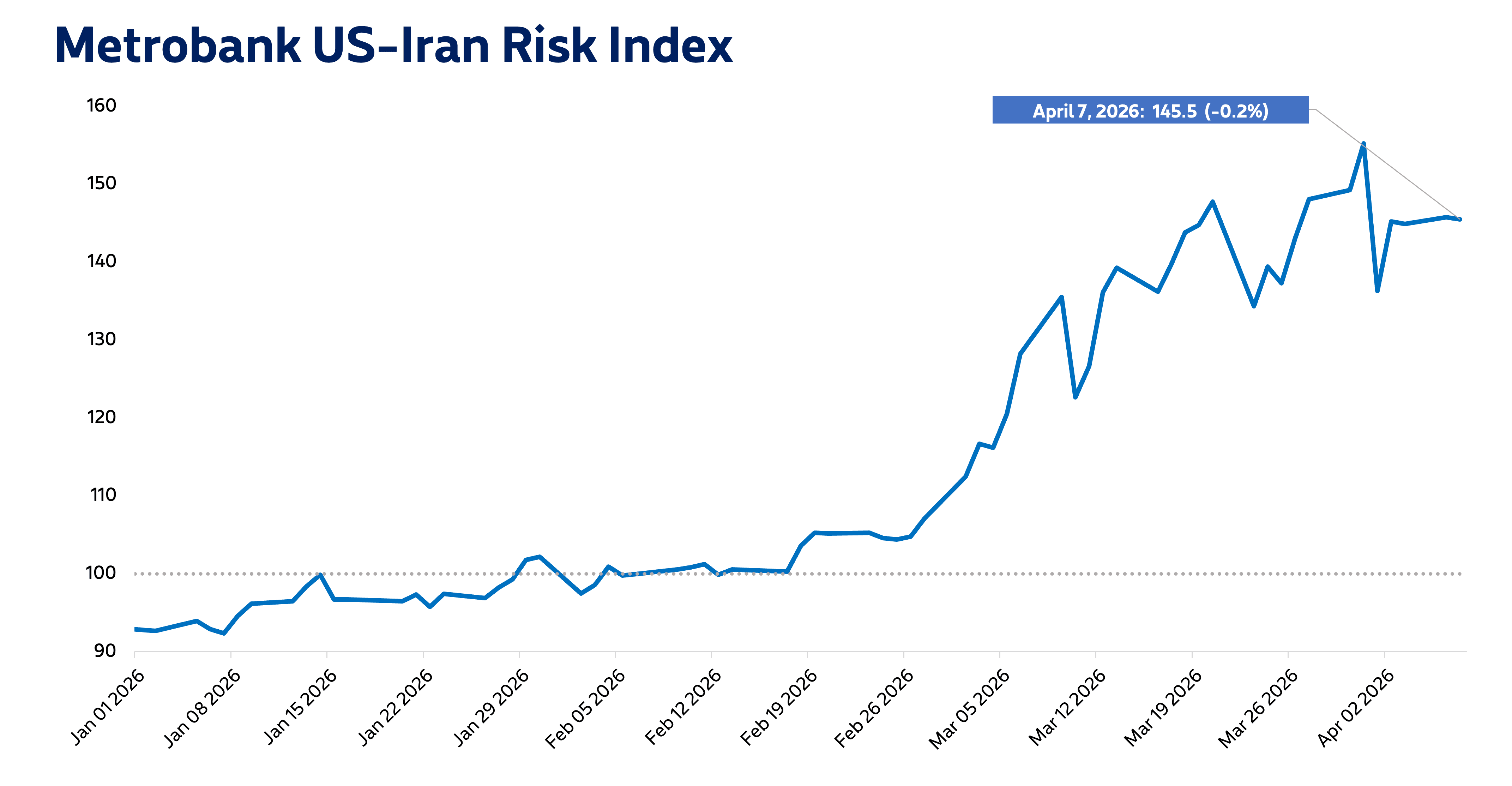
Metrobank’s US-Iran Risk Index settled at 145.5 on April 7, 0.2% lower than its value on the day before.
The US and Iran have agreed to a two-week ceasefire, with US President Donald Trump suspending attacks in Iran if the Strait of Hormuz is reopened during the period, according to Al Jazeera.
Though the ceasefire was announced after US trading hours, market players already priced in hopes for the conflict’s pause during the session, with Brent crude closing marginally lower on Tuesday. Early Wednesday trade has already shown Brent crude fall below USD 100 per barrel, according to data compiled by Bloomberg, with market players pricing in greater relief for oil supply for the next two weeks.
Meanwhile, ceasefire hopes also seeped into global bond yields, with the benchmark 10-year US Treasury yield closing lower by nearly 4 basis points on Tuesday. Dollar strength persisted, though softening safe-haven flows led to the dollar index closing marginally lower on Tuesday.
As market players continue to digest news of the ceasefire, risk levels will likely go down in the coming days, though still elevated, as oil prices fall and near-term inflation expectations temper. Negotiations between the two countries will begin on Friday, according to Al Jazeera, which will be critical in determining the direction of the conflict and market sentiment going forward.
Even as safe passage through the Strait of Hormuz resumes for the next two weeks, Metrobank still sees oil prices staying elevated compared to pre-conflict levels, as the war’s impact on oil facilities will weigh on supply conditions. Moreover, domestic inflation is still expected to accelerate as local energy prices stay high, which will likely compel the Bangko Sentral ng Pilipinas (BSP) to raise their policy interest rate this year. Finally, Metrobank expects the dollar-peso exchange rate to stay elevated, as dollar demand weighs on a weak peso.