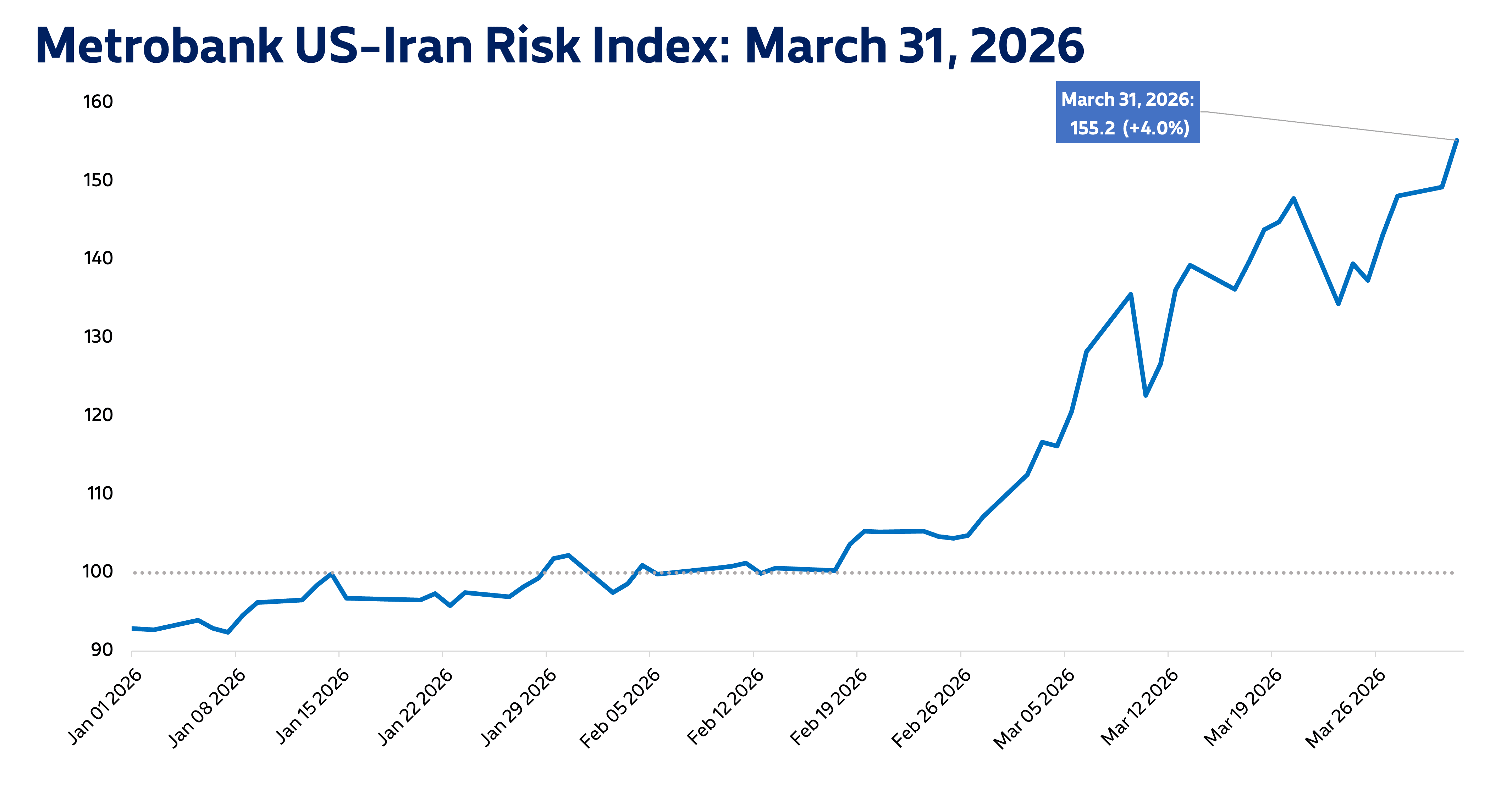
Metrobank’s US-Iran Risk Index settled at 155.2 on March 31, 2026, 4.0% higher than the day prior. This marks another all-time high for the index.
On Tuesday, US President Donald Trump boldly instructed other countries, including the UK, to secure their own oil without the aid of the US, according to Al Jazeera.
While WTI crude prices were little changed after the statement, Brent crude prices, which better reflect the cost of oil outside the US, surged and closed at USD 118 per barrel, according to data compiled by Bloomberg. This accounted for most of the increase in Metrobank’s US-Iran Risk Index on Tuesday.
Meanwhile, Trump also signaled that he is willing to end his military campaign against Iran even as the Strait of Hormuz remains shut, according to the Wall Street Journal. Financial market players took this as a signal of a possible resolution of the conflict, which led to the benchmark 10-year US Treasury yield falling.
The dollar index also pared some of its gains on Tuesday, indicating reduced safe-haven demand for the currency. However, the dollar-peso exchange rate still closed at an all-time high of 60.75 on Tuesday during Philippine trading hours, as a strong dollar still heavily weighed on a weak peso.
Trump recently stated that he expects the war to last two to three more weeks before the US exits Iran, which he claims would lead to a pullback in oil prices, according to Al Jazeera. These statements may provide some relief to financial market players going forward, with oil prices already moving lower during early trade on Wednesday, Philippine time.
Still, Metrobank expects upside oil risk to persist as the Strait of Hormuz, a critical transit point for global oil shipments, remains closed. We also expect the Bangko Sentral ng Pilipinas to raise their policy rate this year to combat rising inflation. Lastly, we see the dollar-peso remaining elevated in the near-future as the dollar continues to strengthen on safe-haven demand.