Economy2 MIN READ

Metrobank US-Iran Risk Index: Stalemate

A lack of progress in US-Iran negotiations is seen keeping market players risk-off in the near-term.
April 28, 2026 by Metrobank, Investment Counselor Department
Share this article:
Featured Article Image

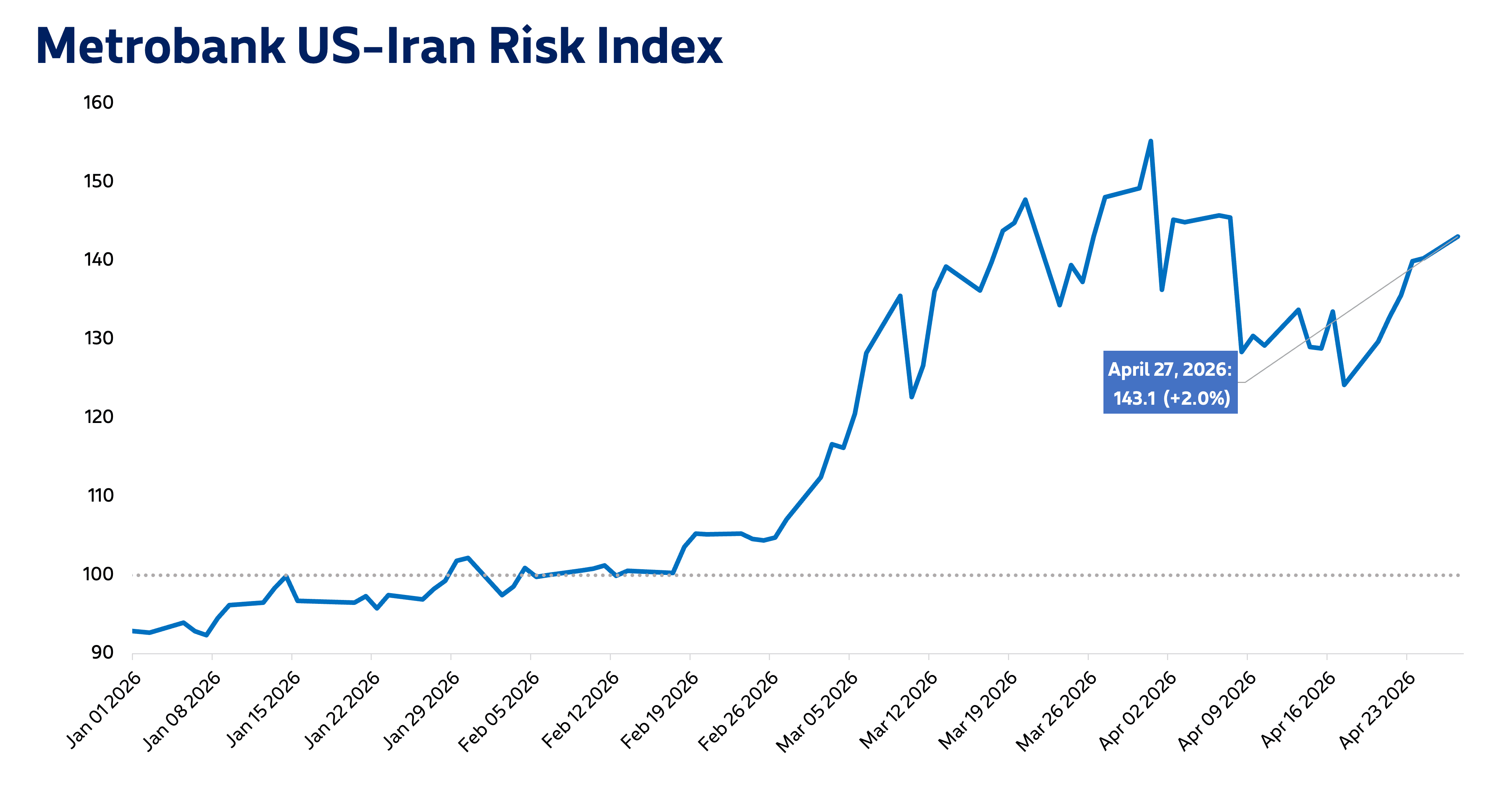
Metrobank’s US-Iran Risk Index settled at 143.1 on April 27, 2.0% higher than its value of 140.3 on April 24.

Financial market players continued to evaluate ongoing oil supply constraints—given the Strait of Hormuz’s closure, the US’s blockade of the strait, and the lack of progress on a resolution to the war. The situation, which is described by some analysts as a stalemate, pushed the commodity’s price higher. Brent Crude closing at USD 108 per barrel on Monday, its highest level in several weeks, according to data compiled by Bloomberg.

Higher oil prices also pushed the benchmark 10-year US Treasury yield upward on Monday, US trading. It was propped up by expectations that the US Federal Reserve (Fed) will hold their policy interest rate steady this week.  

Meanwhile, the US dollar also maintained its strength against the Philippine peso during Monday’s trading day, Philippine time, with the dollar-peso exchange rate closing slightly higher at 60.71 on Monday.

According to Reuters, the US government is currently reviewing a proposal by Iran to end the war, which includes a deferral of nuclear negotiations between the two countries. Representatives of the US government have already stated their dissatisfaction with the proposal, the news agency reported, once again dashing hopes for a swift end to the conflict and keeping market players risk-off.

Metrobank still sees high risk and volatility in the near-term, as the path towards a resolution remains uncertain. Oil prices are poised to stay high as global supply remains constricted. Consequently, domestic inflation is expected to accelerate, on rising local energy prices.  

Moreover, the Bangko Sentral ng Pilipinas (BSP) raised their policy interest rate last week to stem inflation expectations. Metrobank forecasts at least one more rate hike by the BSP this year. Finally, Metrobank expects the dollar-peso exchange rate to stay elevated, as dollar demand weighs on a weak peso. 

Metrobank’s US-Iran Risk Index measures the amount of risk that the ongoing conflict presents to financial markets. It considers the general risk sentiment of investors and inflationary pressure brought by the conflict. A value of 100 denotes a normal level of risk based on market levels prior to the conflict’s escalation, while values greater than 100 imply increasing levels of risk.  

What now?

What now?
Category
Local Fixed Income
Outlook
Bearish
Strategy
Stay defensive in the 2 to 5‑year sector, as foreign exchange‑driven volatility, upcoming bond supply, and potentially more BSP rate hikes may contribute to a steeper curve. Hold-to-maturity clients may consider extending duration to 7 years for yields that continue to remain above the previous year’s highs. 
Category
Local Equities
Outlook
Neutral
Strategy
Maintain a cautiously constructive outlook and lean toward banks, defensive names, and high-quality index stocks that could benefit from improved macroeconomic confidence and a possible relief rally. 
Category
Global Fixed Income
Outlook
Bearish
Strategy
Position in liquid, high-quality papers in the 2- to 5-year space while waiting for clearer signs of risk-on sentiment. Yields are likely to remain rangebound for the week, as markets remain headline-driven related to Middle East developments. 
Category
Global Equities
Outlook
Neutral
Strategy
Maintain a defensive positioning, with a focus on high-dividend and resilient sectors, alongside selective interest in quality growth names amid ongoing volatility. Elevated geopolitical risks are contributing to renewed strength in oil prices through a higher risk premium in energy markets and may continue to limit sustained upside in global equities. 
Category
USD/PHP
Outlook
Neutral
Strategy
Current conditions point to a measured, range-based approach, with caution around USD strength near resistance. Despite support from geopolitical concerns (Brent Crude prices above USD 100) and firmer US data, upside momentum has been limited. The dollar index has struggled to sustain above 99, suggesting consolidation at elevated levels rather than a strong directional USD move. 
Category
G10 Currencies / US Dollar
Outlook
Bearish
Strategy
G10 currencies remain bearish against USD amid elevated geopolitical risk, relatively firm US yields, and reduced confidence in early Fed easing. Focus on defensive positions, favoring relative-value and selective long USD positions. Short-term rebounds in G10 currencies should be treated as corrective unless supported by a clear de-escalation in geopolitical tensions or material deterioration in US macroeconomic data. 
Category
Gold
Outlook
Neutral
Strategy
Brent Crude prices supported above USD 100 are raising flags on global inflation yet again, driving gold’s near-term underperformance versus the US Dollar and Treasuries. Middle East headlines will continue to drive market volatility for now, though the long-term bullish view on gold remains intact. 
(Disclaimer: This is general investment information only and does not constitute an offer or guarantee, with all investment decisions made at your own risk. The bank takes no responsibility for any potential losses.)
Read More Articles About: