Economy2 MIN READ

Metrobank US-Iran Risk Index: No news isn’t good news

Escalating threats and a lack of signals toward the conflict’s resolution pushed risk levels upward.
April 24, 2026 by Metrobank, Investment Counselor Department
Share this article:
Featured Article Image

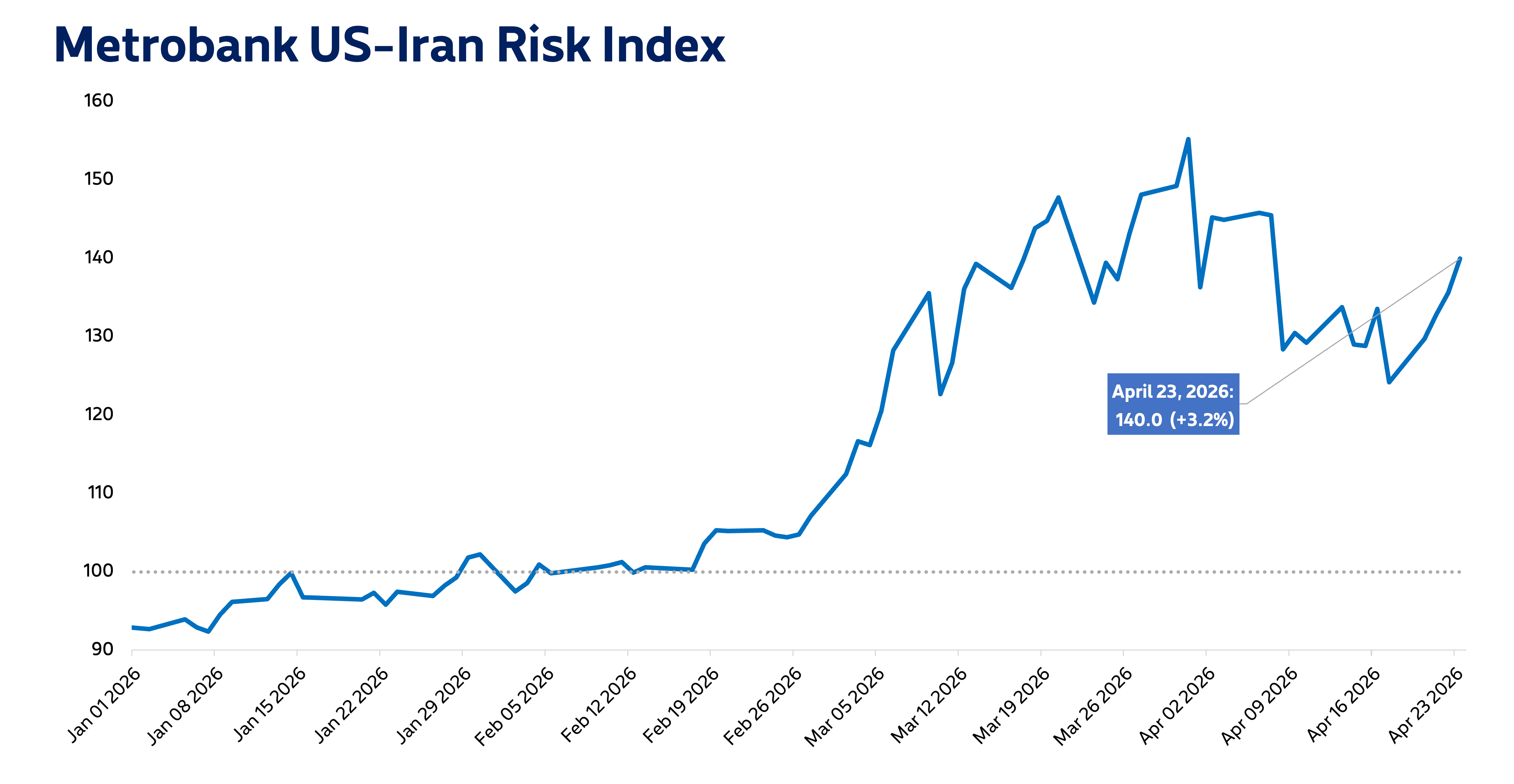
Metrobank’s US-Iran Risk Index settled at 140.0 on April 23, 3.2% higher than the prior trading day.

Tensions intensified on Thursday after the US seized another tanker carrying Iranian oil and US President Donald Trump ordered the US military to “shoot and kill any boat” laying mines along the Strait of Hormuz, according to NBC News. Global oil prices rose as a result, with Brent crude closing at USD 105 per barrel on Thursday, according to data compiled by Bloomberg.

These escalations also contributed to a stronger risk-off sentiment among financial market players, with the US dollar strengthening even further on safe haven flows. The benchmark 10-year US Treasury yield also rose by 2.4 basis points, as threatened oil supply continued to elevate inflation expectations.

There is still no news on when the US and Iran will resume negotiations. As inflation pressure mounts and tensions escalate, expect market players to remain risk-off for the time being.

Metrobank still sees high risk and volatility in the near-term, as the path toward a resolution remains uncertain. Oil prices are poised to stay high, as global supply remains constricted. Consequently, domestic inflation is expected to accelerate, on rising local energy prices.

Moreover, the Bangko Sentral ng Pilipinas (BSP) raised their policy interest rate on Thursday to 4.50% to address rapidly rising inflation expectations. Metrobank forecasts at least one more rate hike by the central bank this year as inflation breaches 4%. Finally, Metrobank expects the dollar-peso exchange rate to stay elevated, as dollar demand weighs on a weak peso.

Metrobank’s US-Iran Risk Index measures the amount of risk that the ongoing conflict presents to financial markets. It considers the general risk sentiment of investors and inflationary pressure brought by the conflict. A value of 100 denotes a normal level of risk based on market levels prior to the conflict’s escalation, while values greater than 100 imply increasing levels of risk. 

What now?

What now?
Category
Local Fixed Income
Outlook
Bearish
Strategy
Stay defensive in the 2 to 5‑year sector amid foreign exchange‑driven volatility and upcoming supply, adding when there is a better yield premium. Maintain selective exposure to 7 to 10‑year tenors for carry and relative stability, while positioning for range‑bound, headline‑driven trading.
Category
Local Equities
Outlook
Neutral
Strategy
Expect possible near-term rebound amid BSP rate hike expectations and value buying of sold-off names. Gains may remain capped, however, amid oil-price volatility and developments in the Middle East. Buy on dips and take profit during highs.
Category
Global Fixed Income
Outlook
Bearish
Strategy
Position in liquid, high-quality papers in the 2- to 5-year space while waiting for clearer signs of risk-on sentiment. Yields are likely to remain rangebound for the week, as markets remain headline-driven related to Middle East developments.
Category
Global Equities
Outlook
Neutral
Strategy
Maintain a defensive positioning, with a focus on high-dividend and resilient sectors, alongside selective interest in quality growth names amid ongoing volatility. Elevated geopolitical risks are contributing to renewed strength in oil prices through a higher risk premium in energy markets and may continue to limit sustained upside in global equities.
Category
USD/PHP
Outlook
Bullish
Strategy
USD/PHP has moved within the 59 to 60 levels in the past few days on volatile geopolitical developments, with market players once again bracing for a protracted conflict and the potential for hawkish central bank pivots in response to current events. Still, rising importer demand around mid-year and a weaker peso will likely elevate spot in the coming months, so opportunistic buying at dips is ideal.
Category
G10 Currencies / US Dollar
Outlook
Bearish
Strategy
G10 currencies are expected to remain under pressure this week, as the sudden escalation in the Middle East forces investors into the safety of the US Dollar. Primary strategy is to limit exposure on G10, prioritizing short position in currencies vulnerable to energy shocks, while monitoring the US yield curve for signs of flattening that would confirm a sustained flight-to-quality. Remain defensive and capitalize on USD strength during geopolitical volatility and maintain stop-losses to account for sudden diplomatic breakthroughs.
Category
Gold
Outlook
Neutral
Strategy
Fund outflows from safe haven US Treasuries and the dollar have found their way back into gold and precious metals. While near term resistance remains at USD 4,900 to USD 5,000 on residual risks, a long-term bullish view on gold remains intact, as global central banks continue to diversify reserves away from the USD and US Treasuries.
(Disclaimer: This is general investment information only and does not constitute an offer or guarantee, with all investment decisions made at your own risk. The bank takes no responsibility for any potential losses.)
Read More Articles About: