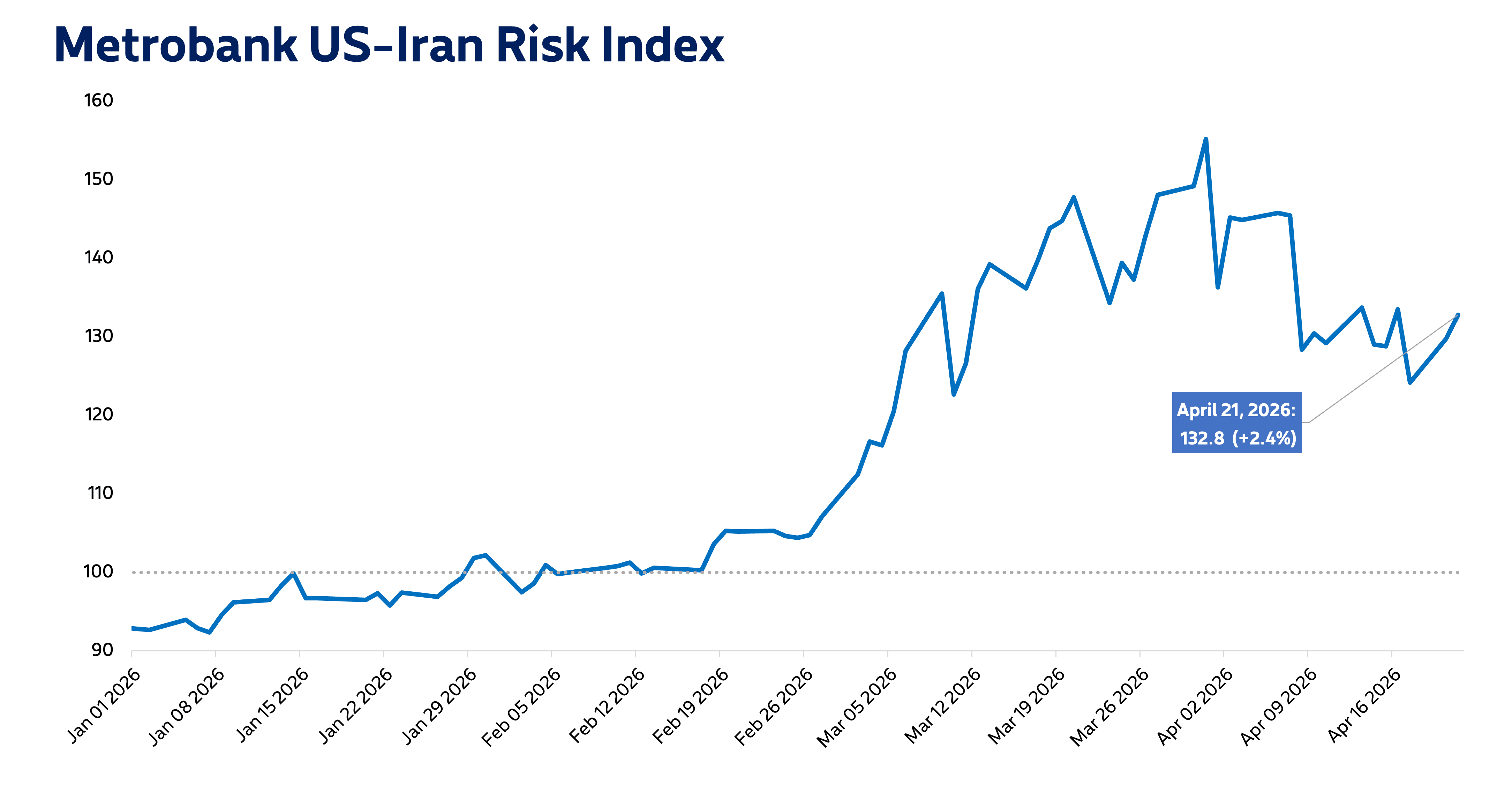
Metrobank’s US-Iran Risk Index settled at 132.8 on April 21, 2.4% higher than the prior trading day.
Risk levels continued to rise on Tuesday, as the path toward US-Iran peace talks and a potential resolution to the conflict remained uncertain. Financial market players continued to price in the Strait of Hormuz’s closure, with Brent crude rising to USD 98.48 per barrel by the trading day’s close on Tuesday, according to data compiled by Bloomberg
Rising oil prices continued to drive inflation expectations upward, leading to the benchmark 10-year US Treasury yield climbing by nearly 4 basis points on Tuesday, according to data compiled by Bloomberg. Mounting uncertainties regarding the conflict also led to increased safe-haven demand for the US Dollar, resulting in the dollar index also climbing on Tuesday.
Last night, US President Donald Trump extended the US’s ceasefire with Iran indefinitely until the latter can “come up with a unified proposal,” according to Al Jazeera. Though this extension may provide some relief to market players, sentiment will still be largely driven by oil supply expectations and chances of a resolution to the war.
With the Strait of Hormuz still closed and the US reinforcing its blockade of Iranian ports, market players will continue to price in higher risks. Early trade on Wednesday shows that even with the extension, oil prices have remained elevated.
Metrobank still sees elevated risk and volatility in the near-term, as the path toward a resolution remains unclear. Oil prices are poised to stay high as global supply remains constricted. Moreover, domestic inflation is expected to accelerate, as local energy prices stay high, which will likely compel the Bangko Sentral ng Pilipinas (BSP) to raise their policy interest rate this year. Finally, Metrobank expects the dollar-peso exchange rate to stay elevated, as dollar demand weighs on a weak peso.