Economy3 MIN READ

Metrobank US-Iran Risk Index: Short-lived reopening

Financial markets were volatile following the Strait of Hormuz’s short-lived reopening and Iran’s rejection of talks with the US.
April 20, 2026 by Metrobank, Investment Counselor Department
Share this article:
Featured Article Image

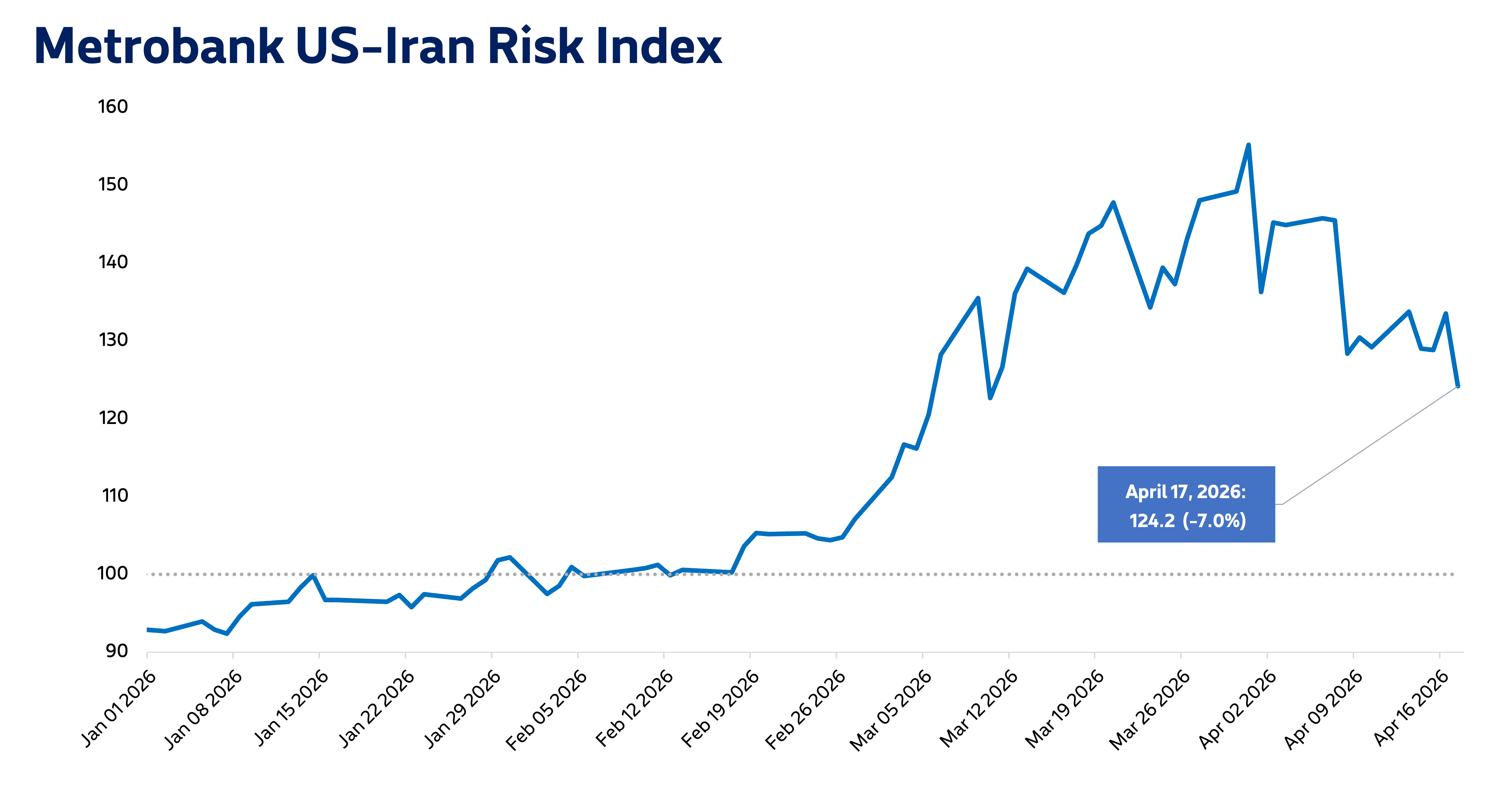
Metrobank’s US-Iran Risk Index settled at 124.2 on April 17, 7.0% lower than the prior trading day and its lowest level in over a month.


Though risk levels eased on Friday due to the Strait of Hormuz’s “reopening,” this was quickly undone over the weekend due to the strait being closed again following the US’s seizure of an Iranian cargo ship. Though Brent crude closed 9.1% lower at USD 90.38 per barrel on Friday, the commodity has already retraced its losses in early Monday trade, opening at USD 96.12, according to data compiled by Bloomberg.


Moreover, the US dollar is also expected to rebound from its downward move last week, as rising risk levels renewed safe-haven flows to the currency. Heightened tensions will also likely elevate the 10-year US Treasury yield going forward, as concerns over faster inflation resurface.


With the Strait of Hormuz closed once again and news that Iran has rejected a second round of talks with the US, according to Reuters, risk levels will likely rise, as tensions reignite. Financial market players are bracing for another turbulent week ahead.


Metrobank still sees high risk and volatility in the near-term. Oil prices are poised to stay elevated, as global supply remains constricted. Moreover, domestic inflation is expected to accelerate, as local energy prices stay high, which will likely compel the Bangko Sentral ng Pilipinas (BSP) to raise their policy interest rate this year. Finally, Metrobank expects the dollar-peso exchange rate to stay elevated, as dollar demand weighs on a weak peso.

Metrobank’s US-Iran Risk Index measures the amount of risk that the ongoing conflict presents to financial markets. It considers the general risk sentiment of investors and inflationary pressure brought by the conflict. A value of 100 denotes a normal level of risk based on market levels prior to the conflict’s escalation, while values greater than 100 imply increasing levels of risk.  

What now?

What now?
Category
Local Fixed Income
Outlook
Bearish
Strategy
Stay defensive on duration amid elevated foreign exchange volatility. Focus on liquid 2–5-year tenors and add only on pronounced yield spikes. Avoid extending duration, especially at the long end of the yield curve, until peso conditions and global risks show clear signs of stabilization.
Category
Local Equities
Outlook
Bearish
Strategy
Expect bargain hunting of cheaper names in the near term. However, gains may remain capped amid oil-price volatility and developments in the Middle East. Buy on dips and take profit during rallies.
Category
Global Fixed Income
Outlook
Bearish
Strategy
Stay in high-quality bonds in the 2- to 5-year sector as the defensive play despite easing geopolitical tensions. Yields may stay rangebound for the week, as global markets stay tuned in for further news.
Category
Global Equities
Outlook
Neutral
Strategy
Maintain a defensive approach by prioritizing high-dividend sectors while taking advantage of volatility to accumulate select quality-growth names.
Category
USD/PHP
Outlook
Rangebound
Strategy
Buy US dollars on dips or near the 59.85-60.15 support levels, as short-term fundamentals favor a mildly firmer USD after the US Federal Reserve (Fed) maintained its policy. Still, elevated energy prices and geopolitical risk will continue to fuel demand for USD.
Category
G10 Currencies / US Dollar
Outlook
Bearish
Strategy
Major G10 currencies saw a brief rally heading into April, as US President Trump issued statements that military operations in Iran were nearing completion.  However, conflicting statements from Iranian officials offer little hope for normalization of energy prices in the near term.  Further, the US Dollar sees additional support following strong US labor data in March, reinforcing expectations of a less dovish Federal Reserve. 
Category
Gold
Outlook
Slightly Bearish
Strategy
Consistently elevated oil prices have driven hotter US inflation and delayed Fed rate cut expectations, contributing to a stronger US dollar and lower gold prices. The precious metal dropped by 12% throughout March and remains at USD 4,600 to USD 4,700 levels. The unpredictability of the situation, re-escalation of the conflict, higher oil prices, and a potentially more hawkish Fed may bring gold lower to our target entry levels of USD 3,800 to USD 4,200. Our long-term view is still for gold to outperform as global central banks diversify their reserve assets away from USD and US Treasuries.
(Disclaimer: This is general investment information only and does not constitute an offer or guarantee, with all investment decisions made at your own risk. The bank takes no responsibility for any potential losses.)
Read More Articles About: