Economy3 MIN READ

Metrobank US-Iran Risk Index: Starting over

Market players look toward a potential resumption of talks between the US and Iran.
April 16, 2026 by Metrobank, Investment Counselor Department
Share this article:

Featured Article Image

Metrobank’s US-Iran Risk Index settled at 128.8 on April 15, 0.2% lower than its value of 129.0 on April 14.

Oil prices moved downwards on Tuesday and held steady on Wednesday as market players remained optimistic about a potential deal between the US and Iran. This comes after a report from Al Jazeera that a Pakistani delegation was in talks with Iran to pursue another round of negotiations with the US. Brent crude, the benchmark for global oil prices, closed at nearly USD 95 per barrel as a result.

Moreover, the dollar index reached its lowest value in over a month, according to data compiled by Bloomberg, as market optimism for a deal led to reduced demand for the currency as a safe haven. Meanwhile, the benchmark 10-year US Treasury yield rose marginally by nearly 4 basis points as investors held their breath for news of a deal on the horizon.

Market players will keep monitoring news on the state and direction of US-Iran negotiations, which will continue to drive the general risk appetite and sentiment of investors in the days ahead.

Metrobank still sees high risk and volatility in the near-term as market players’ moves will likely be in reaction to headlines and developments in the conflict. Oil prices are poised to stay high as global supply remains constricted. Moreover, domestic inflation is expected to accelerate, as local energy prices stay high, which will likely compel the Bangko Sentral ng Pilipinas to raise its policy interest rate this year. Finally, Metrobank expects the dollar-peso exchange rate to stay elevated, as dollar demand weighs on a weak peso. 
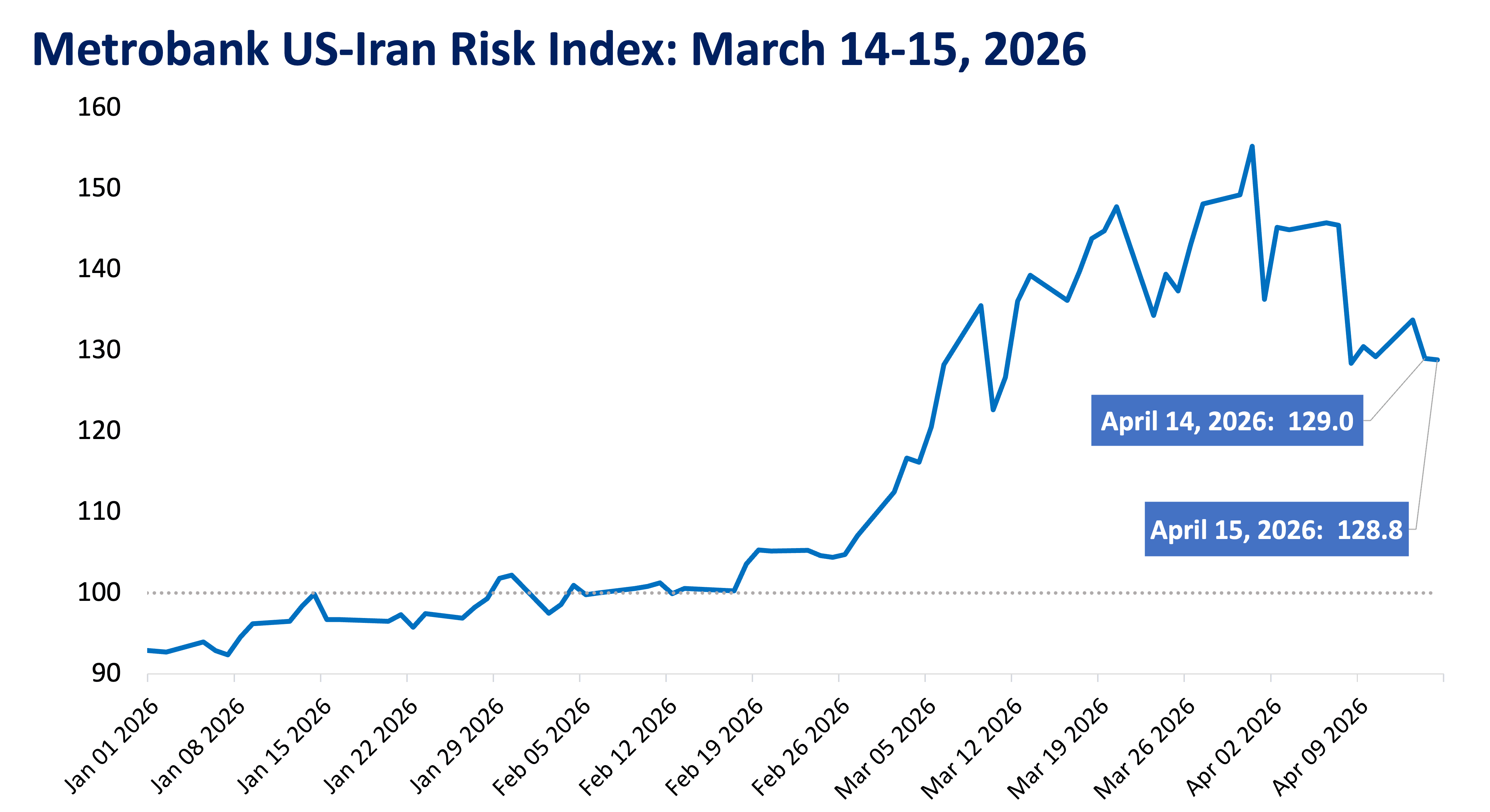
Metrobank’s US-Iran Risk Index measures the amount of risk that the ongoing conflict presents to financial markets. It considers the general risk sentiment of investors and inflationary pressure brought by the conflict. A value of 100 denotes a normal level of risk based on market levels prior to the conflict’s escalation, while values greater than 100 imply increasing levels of risk.  

What now?

What now?
Category
Local Fixed Income
Outlook
Bearish
Strategy
Stay defensive in the 2 to 5‑year sector amid foreign exchange‑driven volatility and upcoming supply, adding when there is a better yield premium. Maintain selective exposure to 7- to 10‑year tenors for carry and relative stability, while positioning for range‑bound, headline‑driven trading.
Category
Local Equities
Outlook
Bearish
Strategy
Expect bargain hunting of cheaper names in the near term. However, gains may remain capped amid oil-price volatility and developments in the Middle East. Buy on dips and take profit during rallies.
Category
Global Fixed Income
Outlook
Bearish
Strategy
Position in liquid, high-quality papers in the 2- to 5-year space while waiting for clearer signs of risk-on sentiment. Yields are likely to remain rangebound for the week, as markets remain headline-driven related to Middle East developments.
Category
Global Equities
Outlook
Neutral
Strategy
Maintain a defensive positioning, with a focus on high-dividend and resilient sectors, alongside selective interest in quality growth names amid ongoing volatility. Elevated geopolitical risks are contributing to renewed strength in oil prices through a higher risk premium in energy markets and may continue to limit sustained upside in global equities.
Category
USD/PHP
Outlook
Bullish
Strategy
Market optimism for a deal between the US and Iran has led to notable outflows from the US dollar as a safe-haven asset. USD/PHP has moved within the 59-60 levels in the past few days, with markets once again bracing for a protracted conflict and the potential for hawkish central bank pivots in response to current events. Still, mid-year seasonality and a weak peso will likely elevate spot in the coming months, so opportunistic buying at dips is ideal.
Category
G10 Currencies / US Dollar
Outlook
Neutral
Strategy
Easing tensions turn G10 currencies broadly bullish as markets turn optimistic on the likely second round of US-Iran talks. Year-to-date, the outperformer is the AUD, while growth and inflation concerns send the JPY to the bottom among major currency peers. While Brent prices have slipped below the 100-mark, global economies remain wary of second-round inflation as prices remain relatively elevated.
Category
Gold
Outlook
Neutral
Strategy
With tensions easing in the Middle East, fund outflows from safe haven US Treasuries and the dollar have found their way back into gold and precious metals. While near-term resistance remains at 4,900 to 5,000 on residual risks, a long term bullish view on gold remains intact as global central banks continue to diversify reserves away from the US dollar and US Treasuries.
(Disclaimer: This is general investment information only and does not constitute an offer or guarantee, with all investment decisions made at your own risk. The bank takes no responsibility for any potential losses.)
Read More Articles About: