


Economy3 MIN READ
Philippine economy to withstand effects of historic wage hike
A mandated wage hike may bring risks, but the economy is well-positioned to cope.
July 10, 2026 by Marian Monette Florendo Obias
Share this article:
The PHP 85 wage hike may be a historic one in the metro. It is the biggest increase ever in the National Capital Region (NCR).
But should we worry about its effects on businesses and the overall economy?
Let’s have a quick review what it’s all about.
The wage increase was approved on June 30, 2026, by the Regional Tripartite Wages and Productivity Board. All minimum wage workers in the NCR welcome this.
It will not be a single increase, though. It will be implemented in two tranches: PHP 60 on July 17, 2026, and the remaining PHP 25 on January 20, 2027. The last wage adjustment was PHP 50 which took effect in June 2025.
NCR minimum wage workers will now earn PHP 780 per day once fully implemented. Nevertheless, this remains well below the PHP 100 - 200 nationwide wage hike proposal in Congress.
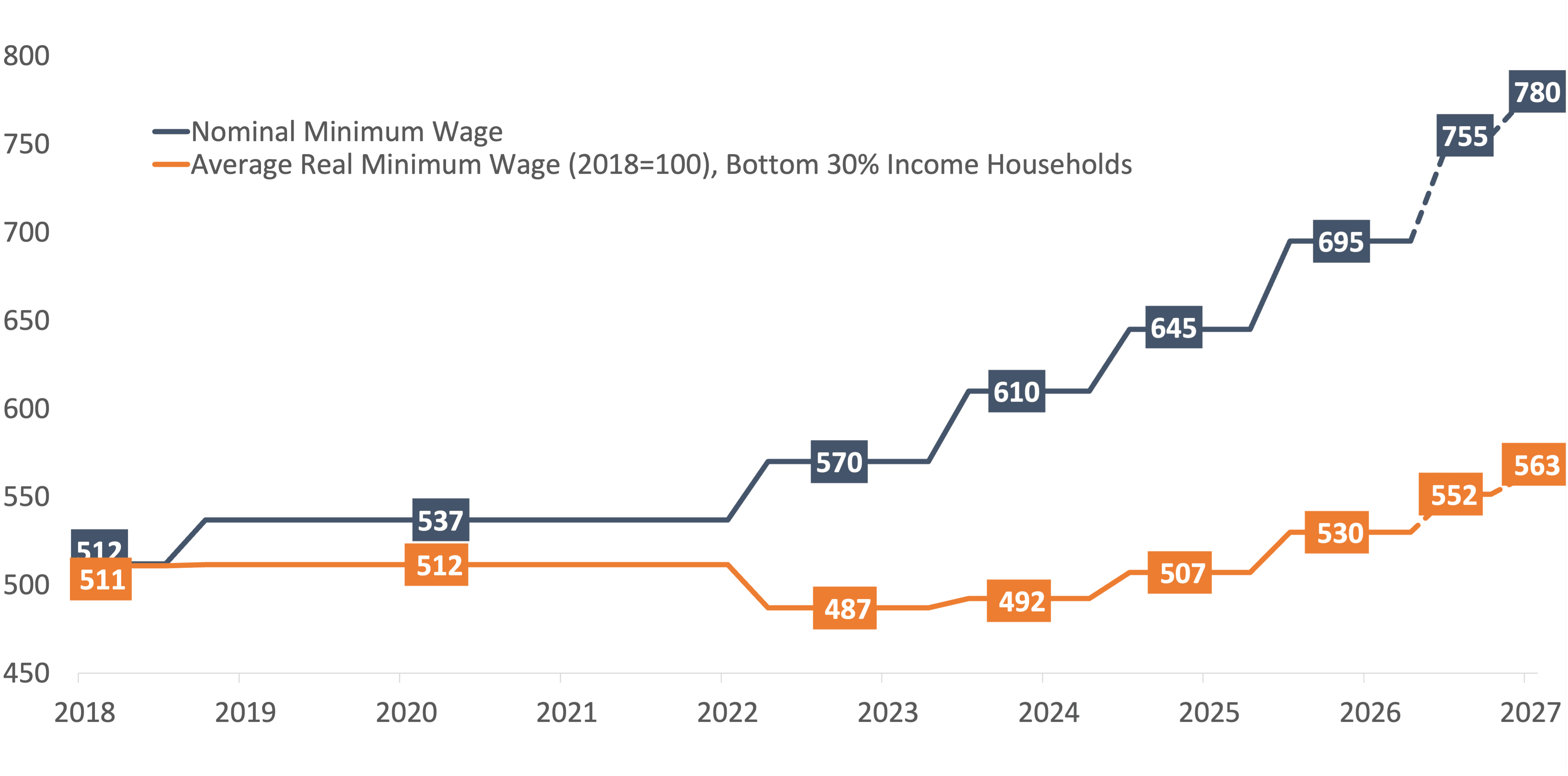
The minimum wage earners, which are estimated at around 1.1 million workers according to Department of Labor and Employment (DOLE), are most likely concentrated within the country’s bottom 30% income households. The figure below shows an estimate of the real minimum wage over time.
Source: Bloomberg, Philippine Statistics Authority, Author's own estimates
Prior to the implementation of the first tranche of the latest minimum wage hike, the average minimum wage had a real purchasing power of only PHP 530 in 2018 prices. While the latest wage hike is now a 52% increase from 2018, its increase relative to real value has only increased by 10% over the same period.
In other words, based on estimates, the fully implemented PHP 780 daily minimum wage is only equivalent to around PHP 563 in real terms. Wages went up but rising prices reduced what those wages could buy.
Now that we have discussed the impact on minimum wage earners, how about the impact on the economy?
It turns out it will have an impact on inflation, employment, and economic growth, albeit minimal.
Higher minimum wages raise labor costs for businesses, particularly for labor-intensive firms in the services sector. As wage expenses rise, profits may be squeezed and businesses may be forced to pass on part of the costs on to consumers through higher prices.
This will result in higher inflation for goods and services heavily dependent on labor inputs. It is then reasonable to expect upward pressure on overall inflation figures.
In the current environment where consumer demand is weak, increasing prices could also curb demand further, thus capping the percentage by which businesses can pass on costs to consumers.
What happens now? To offset higher labor costs, businesses may also trim workers’ hours or reduce hiring. This, in turn, could have an impact on the unemployment rate, albeit marginal, since minimum wage earners comprise roughly only 2% of the country’s 50 million employed individuals.
Now this could have an overall negative impact on economic growth, with the government estimating that a PHP 100 nationwide minimum wage increase could reduce GDP growth by around 0.4 percentage points. However, since the recent historic minimum wage hike only affects 2% of workers nationwide, the impact is expected to be minimal.
The latest wage hike will not be a gamechanger for low-income workers. Improving the welfare of the most vulnerable segments of society will require broader structural reforms and stronger social support measures.
Inflation may rise, employment numbers may take a hit, and growth may slow down. However, the overall impact on the broader economy is expected to remain manageable, particularly if accompanied by complementary government policies.
For investors, looking at the long-term growth story is important. Rising income can help sustain consumer spending over time. This could create opportunities in sectors tied to consumption. Take, for example, retail, food and beverage, and other consumer staples.
The point is, the broader investment outlook is still rosy for investors looking at long-term fundamentals.
MARIAN MONETTE FLORENDO-OBIAS is a Research Officer of the Macro Research Department, Markets Advisory Division, Financial Markets Sector, at Metrobank. She is a Certified Treasury Professional and holds an undergraduate degree in Mathematics from Ateneo de Naga University and an MA Economics degree from UP Diliman. She loves traveling and watching mystery movies in her spare time.