


Economy3 min read
Metrobank US-Iran Risk Index: Searching for clues
Financial market players look for clues on when the conflict will end.
March 25, 2026 by Metrobank Research, Investment Counselor Department
Share this article:

Metrobank’s US-Iran Risk Index settled at 139.5 on March 24, 2026, 3.8% higher than the previous day.
Oil prices remain volatile, with Brent crude recently seesawing above and below the USD 100 per dollar level. Despite claims from US President Donald Trump that discussions were being held to settle the conflict, conflicting statements from Iran have kept markets on edge. The New York Times reported that the US has sent over a 15-point plan to Iran on Tuesday to end hostilities, indicating that efforts are underway to ease tensions.
Still, a lack of clarity on the direction of negotiations have left risk levels in financial markets heightened. The price of Brent crude rose on Tuesday, hitting above USD 100 per barrel. The benchmark 10-year US Treasury yield also rose by nearly 2 basis points as a result. The dollar, meanwhile, maintained its strength overnight on renewed safe-haven flows.
Metrobank maintains the view that oil prices will stay elevated as long as the Strait of Hormuz, a critical transit point for global oil shipments, remains blocked. Meanwhile, high inflation due to rising oil prices will likely compel central banks globally to raise their policy rates this year, including the Bangko Sentral ng Pilipinas (BSP). While dollar strength may be challenged as a result, we still see the dollar-peso exchange rate staying elevated in the near-term as steady dollar demand weighs on a weak peso.
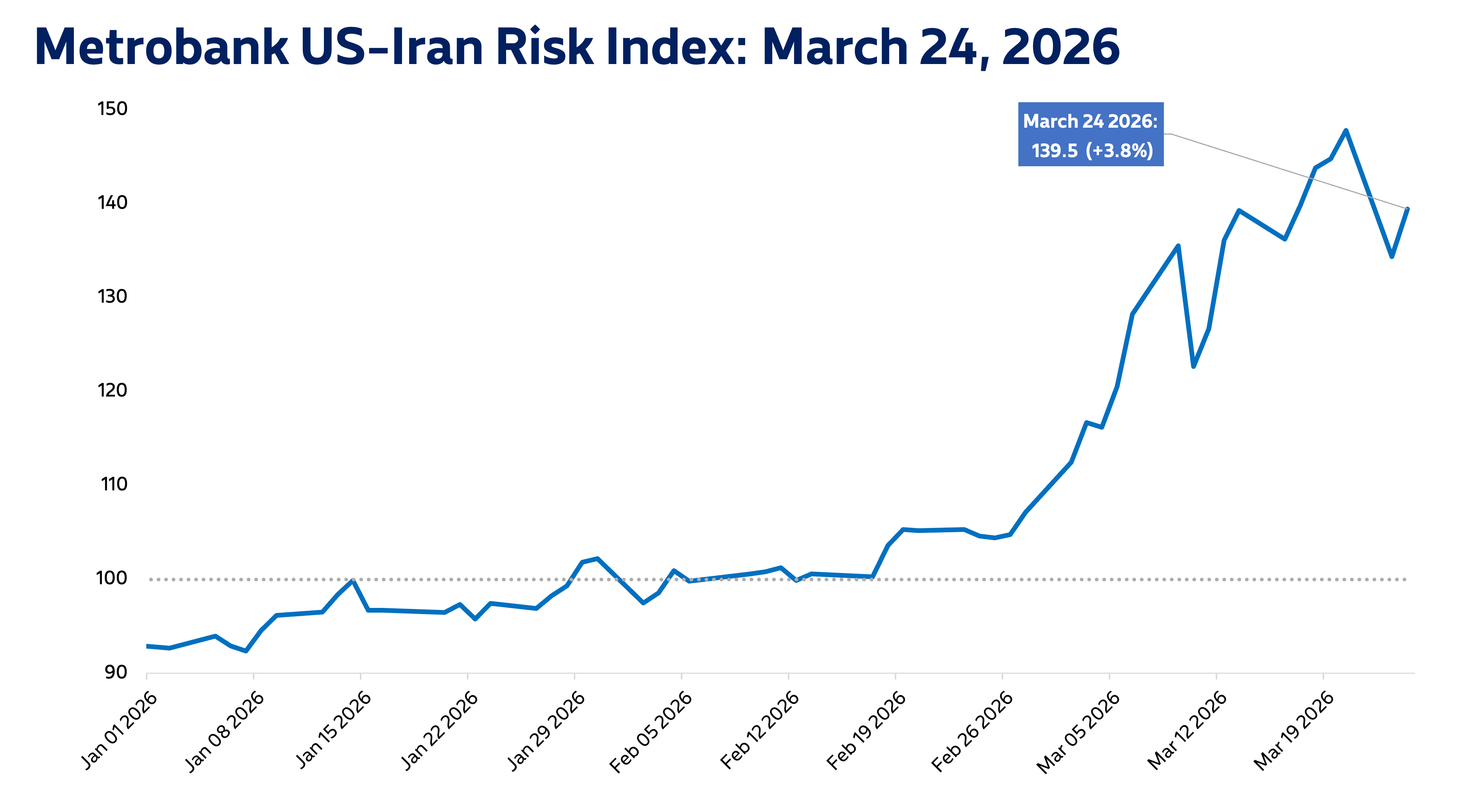
Metrobank’s US-Iran Risk Index measures the amount of risk that the ongoing conflict presents to financial markets. It considers the general risk sentiment of investors and inflationary pressure brought by the conflict. A value of 100 denotes a normal level of risk based on market levels prior to the conflict’s escalation, while values greater than 100 imply increasing levels of risk.