Lack of US Fed forward guidance keeps markets guessing
Markets interpreted US Federal Reserve Chair Kevin Warsh’s Jackson Hole remarks as a strong indication of a rate hike, but that is far from certain.
September 4, 2026 by Sophia Bonifacio
Share this article:
Share this article:
After the speech by US Federal Reserve (Fed) Chair Kevin Warsh at Jackson Hole, markets have become more convinced of a rate hike later this year.
Analysts and investors are increasingly inclined to price in that possibility, interpreting Warsh's remarks as hawkish. That interpretation, however, may be overblown as the central bank eschews forward guidance.
“Work to do” on inflation
The central theme of Warsh’s address was that inflation remains uncomfortably high, and the Fed is not yet convinced that price pressures are cooling rapidly enough towards the 2% target. Warsh explicitly pushed back against the idea that recent softer inflation prints were sufficient, suggesting that the Fed still has “work to do.”
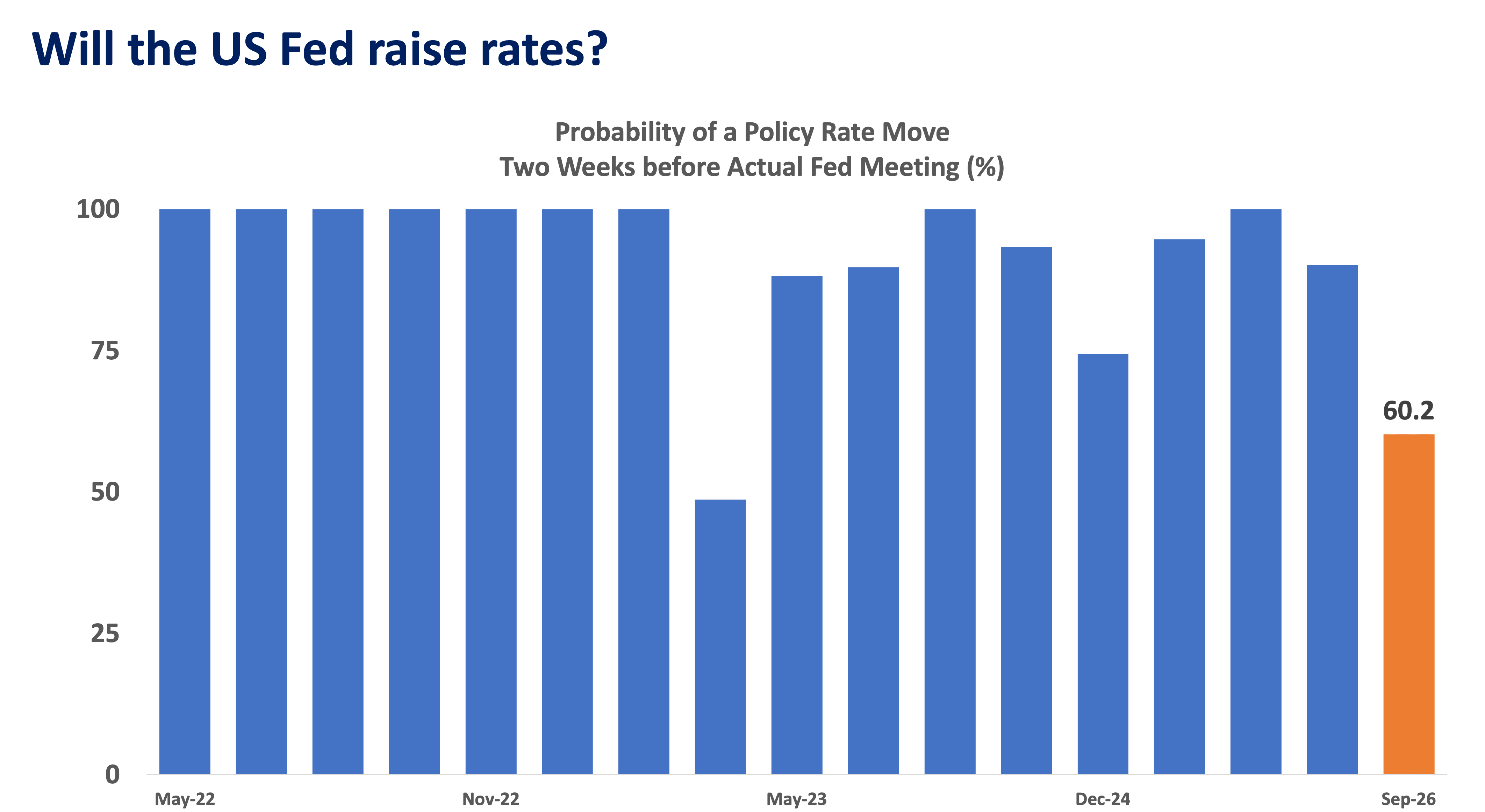
Markets digested this as a signal that further monetary policy tightening is on the table. The probability of a rate hike at the September meeting jumped from roughly 35% to nearly 60% following his remarks.
Expect no forward guidance
Current pricing already shows a near coin toss, despite this rise in rate-hike probabilities. Warsh firmly rejected forward guidance. He said detailed policy signals hamper the Fed's flexibility. He asserts the importance of anchoring policy rate decisions to data, opening the possibility of a rate increase without committing to it.
Source: Bloomberg, US Federal Reserve
Outlook: Monetary policy pause
Despite heightened market expectations for a rate increase, a prolonged pause in the Fed’s policy rate remains highly plausible. The central bank may hold rates steady through the end of the year, particularly as the recent inflation spike driven by the Middle East conflict shows signs of easing as global oil prices retreat.
However, we see significant upside risks in Treasury yields, especially as looming fiscal challenges shape the market narrative.
Treasury yields still face significant upside risks, as looming fiscal challenges heavily influence the market narrative. The historic USD 40 trillion threshold for US national debt has recently been breached, and current projections suggest the federal government could reach its debt limit in 2027.
A deteriorating fiscal trajectory historically places upward pressure on long-term Treasury yields, as investors demand a higher term premium to compensate for expanding debt. Given these headwinds, the broader outlook for global fixed income leans slightly bearish. The US Treasury yield curve remains highly sensitive to shifting monetary and fiscal developments.
Until the Fed's stance becomes clearer and fiscal pressures stabilize, investors are best positioned to remain defensive, concentrating allocations at the short end of the curve to mitigate risk.
(Disclaimer: This is general investment information only and does not constitute an offer or guarantee, with all investment decisions made at your own risk. The bank takes no responsibility for any potential losses.)
SOPHIA THERESE “PIA” BONIFACIO is a Research Officer at Metrobank, covering local and offshore macroeconomic research. She obtained her Bachelor’s degree in Economics with a Specialization in Financial Economics, cum laude, from the Ateneo de Manila University and is a Certified UITF Sales Personnel and a Certified Trust Professional. Pia enjoys long road trips and loves a good cup of hojicha latte.