HOUSTON – Oil prices rallied on Thursday on growing disruption to global oil supplies caused by the US-Israeli war with Iran, with US futures prices rising faster than the international benchmark Brent futures as Washington said it may take action in the futures market to combat rising energy prices.
US West Texas Intermediate crude settled up USD 6.35, or 8.51%, to USD 81.01, its highest since July 2024. Brent crude settled up USD 4.01, or 4.93%, at USD 85.41 per barrel, a fifth session of gains.
The divergence between the two benchmarks was most pronounced around 1500 ET. The two contracts typically trade in lockstep unless there is a specific change impacting supply or demand relevant to one of the benchmarks.
The US Treasury Department may take action in the oil futures market as part of measures to combat rising energy prices expected to be announced as soon as Thursday, a senior White House official said.
President Donald Trump said on Thursday he was not concerned about rising US gas prices driven by the widening Iran conflict, telling Reuters in an exclusive interview that the US military operation was his priority. Trump also said that the United States wanted to be involved in choosing Iran’s next leader.
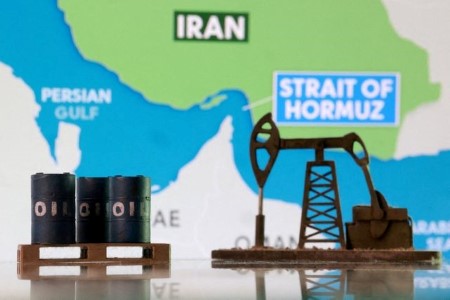
Iraq and Qatar have already shut in oil and gas production due to the shipping paralysis through the Strait of Hormuz. Iraq shut down nearly 1.5 million barrels per day of crude production because it is running out of storage for the oil it produces without oil tankers to take it away. Qatar has shut down its production of liquefied natural gas (LNG) for the same reason LNG tankers cannot traverse the Hormuz shipping chokepoint. Kuwait and the UAE could be next to cut supply as storage space runs out, according to analysts, traders and sources.
“There is no movement in the Strait of Hormuz so prices will grind higher, and with countries having to shut in production then we will be delayed even longer because it is not like you can just resume production at full strength, that will be a problem for a while,” said John Kilduff, partner at Again Capital.
Around a fifth of global oil flows through the Strait.
Dennis Kissler, senior vice president of trading at BOK Financial, said “… if this persists into next week, the eventual re-starting of production and re-vamping of shipping once the Strait is re-opened will also take time to get back online.”
CONTINUED ATTACKS ON OIL TANKERS
Attacks on oil tankers continued on Thursday in the Gulf, as the Bahamas-flagged crude oil tanker Sonangol Namibe reported its hull was breached after a blast near Iraq’s port of Khor al Zubair.
Those attacks, along with Chinese measures to reduce fuel exports, pushed prices higher, said UBS analyst Giovanni Staunovo. The refined product market is also showing signs of stress due to missing Middle East exports, he added.
Some oil refineries in the Middle East, China and India shut their crude units because of the conflict in the Middle East.
As a result of a lower supply outlook in fuel markets, US diesel futures HOc1 jumped 10%, reaching just over USD 3.60 a gallon during the session.
Around 300 oil tankers remained inside the Strait of Hormuz after vessel traffic in and out of the chokepoint nearly halted following the outbreak of war, according to ship tracking data from Vortexa and Kpler that excludes some of the smallest tankers.
(Reporting by Georgina McCartney in Houston, Enes Tunagur in London, Katya Golubkova in Tokyo, and Siyi Liu in Singapore; Additional reporting by Stephanie Kelly in London; Editing by Andrei Khalip, Kirsten Donovan, David Gregorio, and Stephen Coates)