





 DOWNLOAD



Ask Your Advisor: Can my portfolio survive a market crash?
If financial markets crash, would you know what happens to your investments? Know how stress testing your portfolio can help you prepare for tough times.
 By Janssen Roman



Imagine waking up, reading bad news, and seeing financial markets in the red. Would you know what this means for your portfolio?
The uncomfortable truth is markets don’t fall gently. When stress and shocks hit, prices move fast and assets that once felt “safe” can drop steeply.
If you have not conducted a stress test on your investment portfolio, you may discover its weakness for the first time in the middle of a market sell-off—a time when your emotions are high and making decisions is hard.
Stress testing forces you to ask the tough questions before the panic:
- How much could you lose?
- Which investments would hurt?
- And importantly, can you stay invested?
Preparing and not predicting
Stress testing is not guessing when the next crash will happen. It is like a fire drill for your investment portfolio. You don’t predict if a fire will start tomorrow. Instead, you make sure that if it happens, you know the exits, so you won’t panic.
Financial markets surprise investors. What doesn’t change is how portfolios behave under pressure: correlations rise, liquidity disappears, and losses feel different in real time.
Stress testing helps you see that in advance. It shows you how your portfolio may behave in rough markets. The goal is not to build a crash-proof portfolio, rather to build one you can stick with in challenging times.
What do charts show?
At first glance, Chart 1 is reassuring.
It compares three familiar building blocks of many portfolios: Philippine equities (PSEi), global equities (MSCI ACWI), and government bonds (proxied by GOVT: iShares US Treasury Bond ETF)—with all assets indexed to a base value of 100.
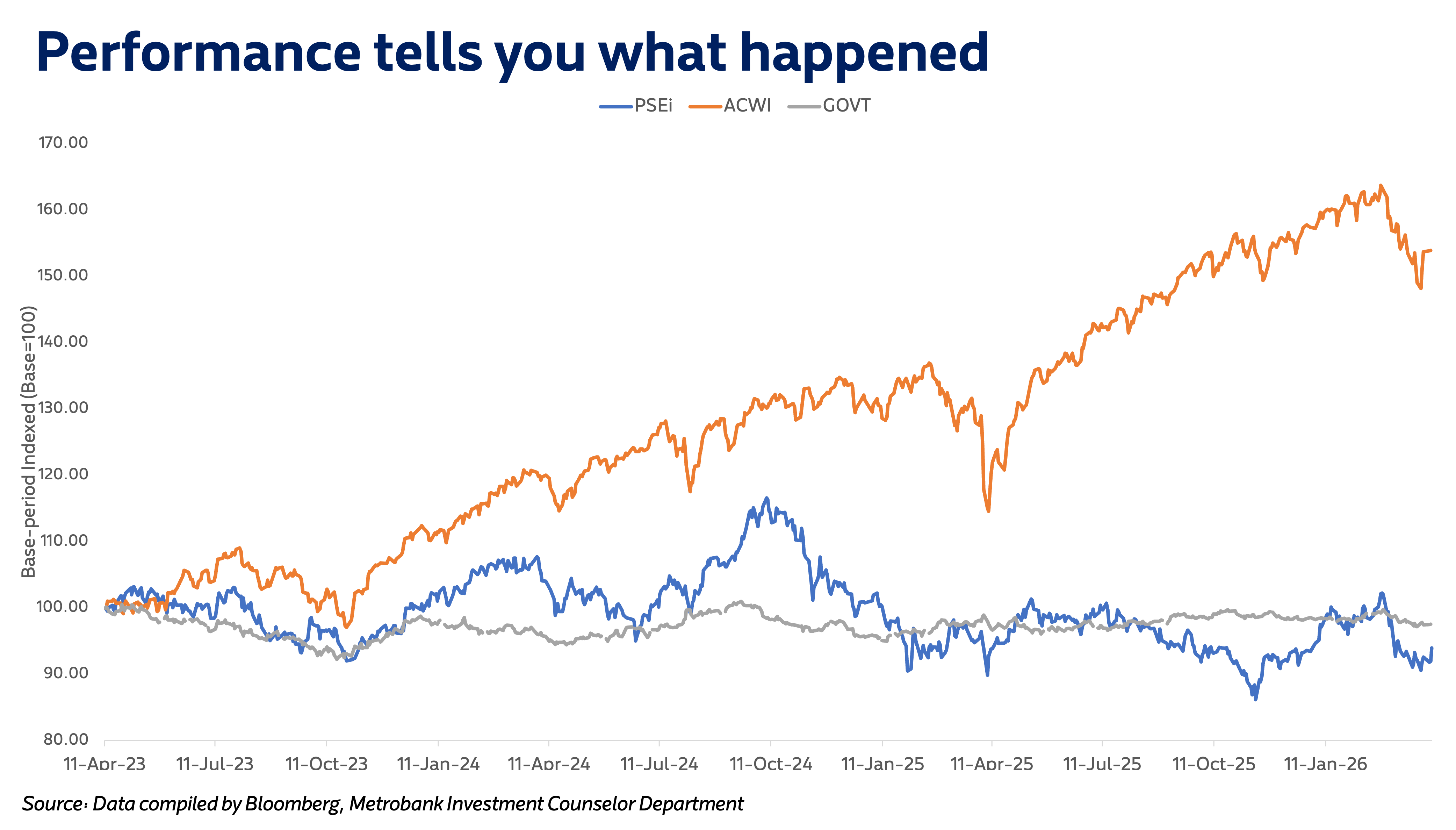
Global equities trend higher over time. Local equities move in cycles. Government bonds appear stable and steady. If you stopped here, it is easy to believe that long-term investing is just about staying invested and tuning out short-term noise.
But this chart hides an important truth. Indexing asset levels shows where investors end up and not what they went through.
Stress testing is not about the outcome. Chart 2 shows short-term rolling volatility for the same three assets: PSEi, MSCI ACWI, and US government bonds.
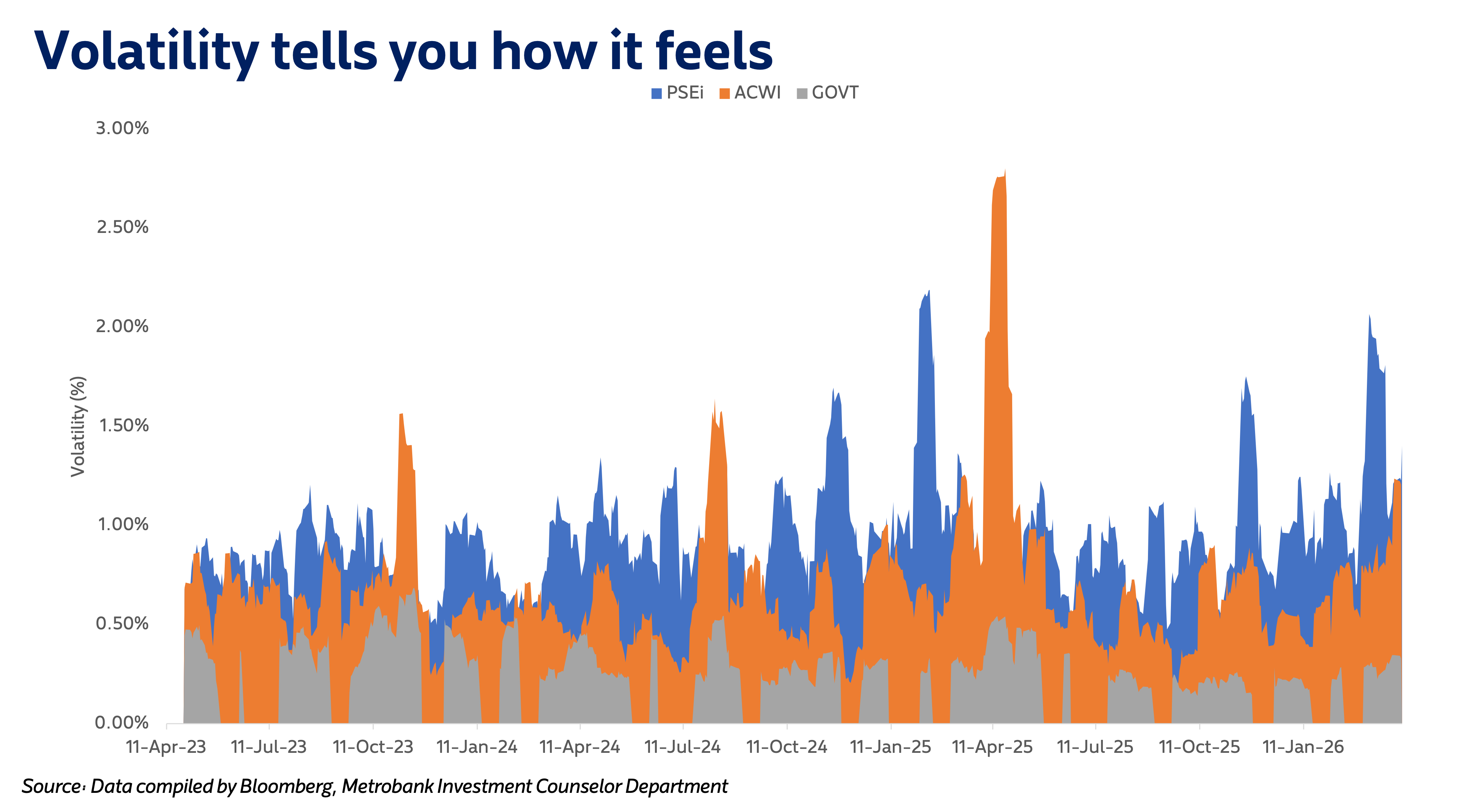
Suddenly, the smooth paths in Chart 1 look different. Periods that appeared calm on a performance chart were marked by:
- Sharp volatility spikes in both global and local equities
- Episodes where PSEi and ACWI became volatile at the same time
- Occasional volatility even in government bonds, especially during periods of interest-rate repricing.
This is a critical stress testing insight: Risk doesn’t rise gradually. It surges—often when investors least expect it.
How to stress test your investment portfolio?
You don’t need advanced models or market forecasts to stress test your portfolio. You need structure, realism, and honesty.
Start by breaking your portfolio into core asset groups—for example, Philippine equities, global equities, government bonds, and cash. These broad buckets will show where most of your risk is.
Next, build simple scenarios.
- What happens if equities fall by 20-30%?
- What if both local and global stocks decline at the same time?
- What if bonds don’t provide much protection due to rising interest rates?
You are not predicting outcomes. You are testing sensitivity—which assets drive losses, and how quickly those losses accumulate.
Then focus on the result that matters the most: portfolio-level impact.
- How much would your total portfolio fall?
- How volatile would it feel over a short period?
- Would you still meet your cash and liquidity needs?
Finally, test your behavior, not just the numbers. If the portfolio loss you see on paper already makes you uneasy, living through it in real time will feel far worse.
Quick stress test checklist
- Do I know how much my portfolio could fall?
- Which asset contributes the most to losses?
- What happens if diversification weakens?
- Do my “defensive” assets reduce volatility?
- How quickly could losses occur?
- Would I need to sell anything at a loss?
- Could I stay invested emotionally?
Stress testing builds confidence, not fear
Financial markets are unpredictable, and stress testing does not stop losses.
But by understanding how your portfolio reacts, you will know where risks truly lie and whether you can stay invested.
The goal is not to predict the next crisis. It is to build a portfolio you can confidently stick with through one.
(Disclaimer: This is general investment information only and does not constitute an offer or guarantee, with all investment decisions made at your own risk. The bank takes no responsibility for any potential losses.)
JANSSEN ROMAN is an Investment Counselor at Metrobank’s Financial Markets Sector, specializing in portfolio strategy, financial modeling, and data‑driven investment analysis. His experience spans roles as an Investment Specialist and Financial Markets Management Trainee at Metrobank, as well as a Research Analyst covering global Mutual Funds and ETFs at FactSet Philippines. He is currently pursuing his Master of Arts in Economics at the Ateneo de Manila University, with a focus on Fiscal Policy and Governance. He also holds a broad range of industry certifications spanning treasury, financial markets securities, financial modeling, data analytics, and process improvement—reinforcing his commitment to technical excellence and professional rigor. Outside of work, he enjoys riding his motorcycle, traveling, and photography.