






 DOWNLOAD



Metrobank US-Iran Risk Index: Fragile ceasefire
Doubts remain despite a temporary respite from hostilities
 By Metrobank Research, Investment Counselor Department



Metrobank’s US-Iran Risk Index settled at 128.4 on April 8 and 130.5 on April 9, easing almost to its lowest levels in nearly a month.
The US and Iran’s two-week ceasefire pushed global oil prices below USD 100 per barrel for the first time in several weeks, as the Strait of Hormuz, a critical transit point for global oil shipments, was reopened. As a result, Brent crude closed at USD 96 per barrel on Thursday, according to data compiled by Bloomberg.
Meanwhile, dollar strength notably waned upon the ceasefire announcement as safe haven flows to the currency continued to soften. The dollar-peso exchange rate closed the Philippine trading day on Wednesday below the 60-level at 59.43, the peso’s strongest showing in nearly a month.
While market players have priced in greater oil supply relief, risk levels remain high as the ceasefire’s stability is called into question. Since the ceasefire’s declaration, US President Donald Trump has already accused Iran of poorly managing oil shipments through the Strait of Hormuz, according to the BBC. Meanwhile, sustained Israeli attacks on Lebanon have also kept markets on edge. With the ceasefire’s fragility being exposed, market players will likely stay cautious going forward.
Metrobank still sees oil prices staying elevated compared to pre-conflict levels, as the war’s impact on oil facilities will weigh on supply conditions. Moreover, domestic inflation is still expected to accelerate as local energy prices remain high, which will likely compel the Bangko Sentral ng Pilipinas (BSP) to raise its policy interest rate this year. Finally, Metrobank expects the dollar-peso exchange rate to stay elevated, as dollar demand weighs on a weak peso.
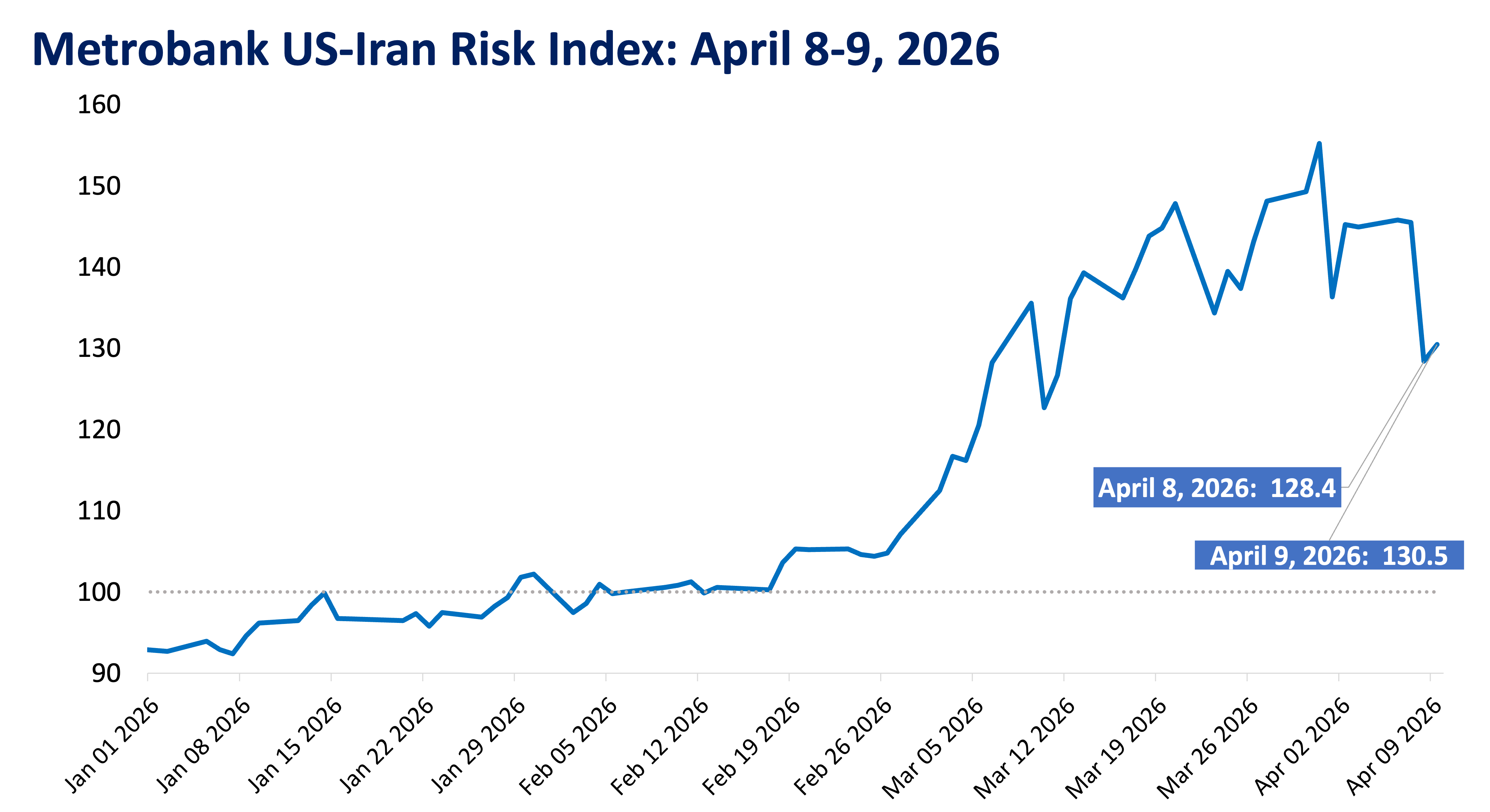
Metrobank’s US-Iran Risk Index measures the amount of risk that the ongoing conflict presents to financial markets. It considers the general risk sentiment of investors and inflationary pressure brought by the conflict. A value of 100 denotes a normal level of risk based on market levels prior to the conflict’s escalation, while values greater than 100 imply increasing levels of risk.
What now?
| Asset Class | Outlook | Strategy |
|---|---|---|
| Local Fixed Income | Bearish | Stay defensive on duration amid elevated foreign exchange volatility. Focus on liquid 2- to 5-year tenors and add only on pronounced yield spikes. Avoid extending duration, especially at the long end of the yield curve, until peso conditions and global risks show clear signs of stabilization. |
| Local Equities | Bearish | Expect bargain hunting of cheaper names in the near term. However, gains may remain capped amid oil-price volatility and developments in the Middle East. Buy on dips and take profit during rallies. |
| Global Fixed Income | Bearish | Stay in high-quality bonds in the 2- to 5-year sector as the defensive play despite easing geopolitical tensions. Yields may stay rangebound for the week, as global markets stay tuned in for further news. |
| Global Equities | Neutral | Maintain a defensive approach by prioritizing high-dividend sectors while taking advantage of volatility to accumulate select quality-growth names. |
| USD/PHP | Rangebound | The USD/PHP exchange rate is expected to remain rangebound, with near‑term price action driven by developments surrounding the US‑Iran ceasefire, potential reopening of the Strait of Hormuz, and broader Middle East spillover risks affecting oil prices and US dollar demand. Buy on dips or near the support 59.30 and 59.00. We still expect a weaker peso given the effects of the war and overall weakness in the Philippine economy. |
| G10 Currencies / US Dollar | Neutral | Still a dollar story, but this time favoring the G10 currencies as US and Iranian leaders agreed to a ceasefire on Wednesday. Majors EUR, GBP, JPY, and CNH promptly rallied on easing risk sentiment but markets remain cautious over the still-fragile situation, with Iran already claiming three breaches out of the 10-point ceasefire framework. Following recent developments and already strong gains, markets will look to clearer signals before taking long positions. |
| Gold | Neutral | Gold saw a modest uplift to USD 4,765.40 (+1.90% week-on-week) on slightly better risk sentiment as safe haven positioning in the US dollar and Treasuries began to flow out. The precious metal advances despite higher-for-longer US Fed outlook, though the fragile US-Iran ceasefire and continued inflationary pressures from elevated oil prices and persistent supply constraints may drive near-term pullbacks. Our target entry range remains at USD 3,800–4,200. Over the long term, the bullish case for gold remains intact as global central banks continue to diversify reserves away from the US dollar and US Treasuries. |
(Disclaimer: This is general investment information only and does not constitute an offer or guarantee, with all investment decisions made at your own risk. The bank takes no responsibility for any potential losses.)